

Assistant Professor Catherine Nakalembe Explores Gap Between Climate Data, Small Farmers in New TED Talk
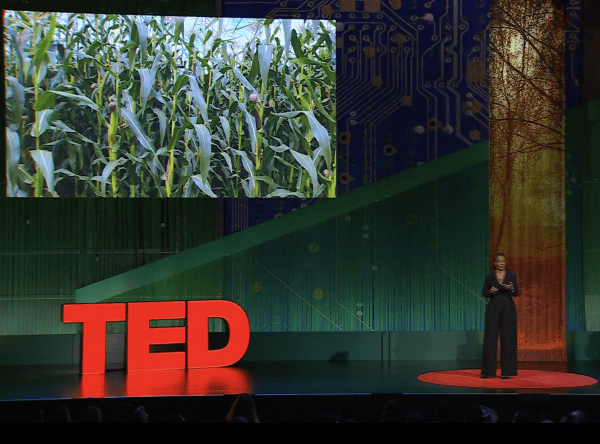
Nakalembe shows how existing tools can better support food security in Africa.
In a new TED Talk, "Why Can't We Better Prepare for Extreme Weather?", Assistant Professor Catherine Nakalembe examines why millions of people continue to face hunger despite advances in satellite technology that can detect droughts and crop failures months in advance.
Nakalembe, NASA Harvest's Africa Program director, explains how climate and agricultural data often fail to reach the communities most vulnerable to food insecurity. Drawing on her work in remote sensing, agriculture and climate science, she exposes the blind spots that prevent life-saving early warning systems from translating into real-world action.
Her talk highlights how satellite data and geospatial tools can provide early signals of floods, droughts and crop failures, but only when paired with effective communication, local partnerships and decision-making frameworks. Nakalembe emphasizes that the challenge is not a lack of technology, but the disconnect between scientific insight and on-the-ground response.
Nakalembe argues for adapting and better deploying existing Earth observation systems to support farmers, governments and humanitarian organizations. She underscores the importance of turning early warning into early action to protect communities increasingly affected by climate variability and food insecurity in Africa.
Nakalembe was also featured in season 2 of the TED Fellows Film Series, which premiered in October 2024.
Related Articles
Assistant Professor Catherine Nakalembe Featured in TED Fellows Film Series
GEOG Assistant Professor Named 2025 Bellagio Center Resident, TED Fellow
Growing Resilience From the Ground, Up
Seeds of Impact: Catherine Nakalembe's Trailblazing Path
Published on Fri, 01/30/2026 - 11:22