Campus Forest Carbon Project

This project aims to inform UMD’s carbon monitoring by accurately estimating the carbon stored in forests on university-owned properties. While much progress has been made to lower University emissions across various other sectors, tree conservation or restoration could further enhance these goals. Measurements of forest carbon gains (or losses) at 30 meter resolution enables accurate measurement of this important aspect of the University’s carbon budget.
Through informed land-use decisions, the University’s Climate Action Plan can also be further developed to reflect our commitment to maintaining or increasing our natural carbon storage capacities. Additionally, this work builds UMD’s capacity to purchase forest-based carbon credits from reliable projects located in Maryland using a consistent scientific approach.
Faculty and students in the Department of Geographical Sciences (GEOG) have been working with the Maryland Department of Natural Resources (MDNR) since 2013, under the auspices of NASA’s Carbon Monitoring System, to implement this carbon monitoring science at the state level and advance the goals of state legislation, including the Greenhouse Gas Reduction Act of 2009, the Tree Solutions Now Act of 2021, and the Climate Solutions Now Act of 2022. (Hurtt et al. 2019).
Further, we have expanded our work with member states of the U.S. Climate Alliance (USCA) to implement this same technology regionally in support of annual carbon budgeting (Ma et al. 2021). By utilizing student support, we can help UMD “walk the walk” and advance our own forest climate goals in parallel with Maryland and other USCA states. The scope of this work also provides UMD the opportunity to influence and improve the carbon budgeting process for other universities.
The Campus Forest Carbon Project 1.0 moved from prototype development to annual forest carbon reporting that can be readily included within the campus carbon budget and inform future land-use planning. The Campus Forest Project 2.0 (2025-2027) aims to maximize integration with state and campus initiatives to promote awareness of forest carbon, particularly by engaging with undergraduate students.
Any questions? Contact us at @email. Want to get involved? Fill out this form.
Campus Forest Carbon Project 2.0
Objectives
- Annual reporting – This project will analyze campus carbon data to provide and support annual reports of forest carbon flux from 2025 to 2027. This responsibility will be returned to undergraduate students in order to advise the University on the projected annual changes. Students will provide updates to the CFCP websites, CFCP StoryMap, as well as UMD’s carbon neutrality stats and websites including the UMD Office of Sustainability Progress Hub.
- Tree planting reporting – This project will track and report annual tree plantings on campus. Tree planting is occurring on campus, but it is not currently included in campus forest carbon reporting or state carbon reporting. This project will address these gaps by including planted tree carbon in the campus carbon budget and enter planted trees into the state tree planting commitment (5 Million Trees).
- Future land-use planning – This project will inform new and reasonable reforestation, tree-planting, and forest management options for the campus in order to consider the effects of climate change. Previous work has successfully calculated the forest carbon potential of the UMD campus under reference (current) climate. New analyses by this project will incorporate the latest results to account for the potential effects of future climate change on forest carbon. Using these climate-informed data to define possible scenarios, the project will provide important insights into the net carbon fluxes resulting from tree planting and tree removal on UMD-owned properties. Working with UMD campus planners and administration, CFCP 2.0 will quantify potential forest carbon losses from new or proposed construction projects on campus as well as suggest future optimal tree planting plans.
- Internal Student Engagement – The student team will engage with other students at the University of Maryland with an interest in climate and sustainability by reaching out through interested campus organizations, providing presentations in related classes, and outreach through the project website and social media. The student team will also collaborate with organizations on campus including the Arboretum, Department of Geographical Sciences, ENSP, College Park Scholars, and Office of Sustainability to ensure direct impact on campus.
- External student engagement – This project will enable external student engagement by creating a multi-university student working group. Working alongside other universities with a focus on climate and sustainability, the project will develop a coalition of multiple schools with an interest in forest carbon in order to grow the initiative and share best practices. There will be regularly scheduled meetings throughout the semester to introduce climate mitigation commitments and allow students to discuss the role of forests at their prospective schools. This will give University of Maryland students the opportunity to share the UMD approach and find ways to continue to improve the techniques.
- Student professional experience – This project will provide research opportunities and professional skills to students at UMD. Students on this project will be conducting research internships using the latest satellite remote sensing and computer modeling techniques and applying those findings directly to campus needs. Students will also share their findings with the larger campus community through on-campus events and externally at professional conferences.
Team
Undergraduate Team Members
- Natalie Rosenthal, ENSP
- Kendi Gray, Linguistics
- Isaac Dworkin, Economics
Timeline
- A campus forest carbon report will be shared with the Office of Sustainability at the end of each year.
- Student engagement will be emphasized throughout this project every year, with events for students to learn more about the project and get involved.
- Students will work with the Arboretum in order to input new tree plantings into the 5 Million Trees database by the end of Year 1, and continue to update information as campus changes.
- The development of campus land-use plans will start in Year 1, be reformed during Year 2, and be presented and shared with campus administration in Year 3.
Accomplishments
- Conferences
- Related Publications
- In the News
Campus Forest Carbon Project 1.0
Objectives
- Historical Analysis – In Year 1, we completed a historical analysis of forest change and associated change in carbon storage and sequestration capacity for nine years (2011-2019). A modeling protocol and python script were developed to allow this analysis to be completed annually using ArcGIS and based on available lidar data and optical imagery. In Years 2 and 3, we further evaluated uncertainty in the derived annual forest carbon estimates relative to the availability and frequency of required data. Specifically, we used Campus Arboretum data to explore potential gaps in tree cover change detection by existing remote sensing tools as well as further validate our current carbon flux estimates. This analysis will enable UMD to understand, in quantitative terms, the improvements offered by this prototype relative to other methods, and further clarify the carbon impact of our land-use decisions.
- Annual updates – As optical imagery became available for 2020 and 2021 respectively, the annual forest carbon inventory was calculated for campus utilizing the established methodology from Step 1. As was done for 2019 data, these estimates were made available for inclusion in the University’s carbon budget process, maximizing student collaboration with the Office of Sustainability (OS) to further emphasize the accounting and planning support this analysis provides. We will continue to generate annual project reports and provide guidance on how forest carbon estimates can be used to build out the forestry component of our campus GHG inventory.
- Future land-use planning – This work also demonstrates the carbon implications of land-use change relative to proposed campus development projects. As our University strives to reduce its carbon emissions, we quantify how the forest carbon wedge of our carbon budget could support this effort and offset the negative impacts of generated GHG emissions in other sectors. For future land use, the project recommended McKeldin Mall, the Golf Course, and the President’s House as areas that could be used to increase carbon storage.
- Informing SIMAP and the “Carbon Commitment” – Working closely with GEOG and the Office of Sustainability, undergraduate students worked along the science, management and policy interface, translating scientific assessment into carbon mitigation and management actions. Of particular importance was making sure all forest carbon estimates for UMD had both campus-level outcomes (project components 2 and 3), as well as showcased UMD leadership towards achieving our “Carbon Commitment.” We presented our work to several schools participating in the Carbon Commitment in Year 1 and this continued in Years 2 and 3.
- Quantifying potential carbon offsets in the state of Maryland – As we work to better account for UMD’s own land-use decisions, there is an adjacent opportunity to expand the application of these same data products to estimate the carbon impact of Maryland reforestation projects and incorporate local carbon credits into UMD’s carbon offsetting program. Traditional carbon offset protocols focus on costly field-based measurements to achieve the highest accuracy, but our method utilizes high-resolution remote sensing and modeling for an innovative offset protocol that makes reliable estimates at a lower cost 1.
Team
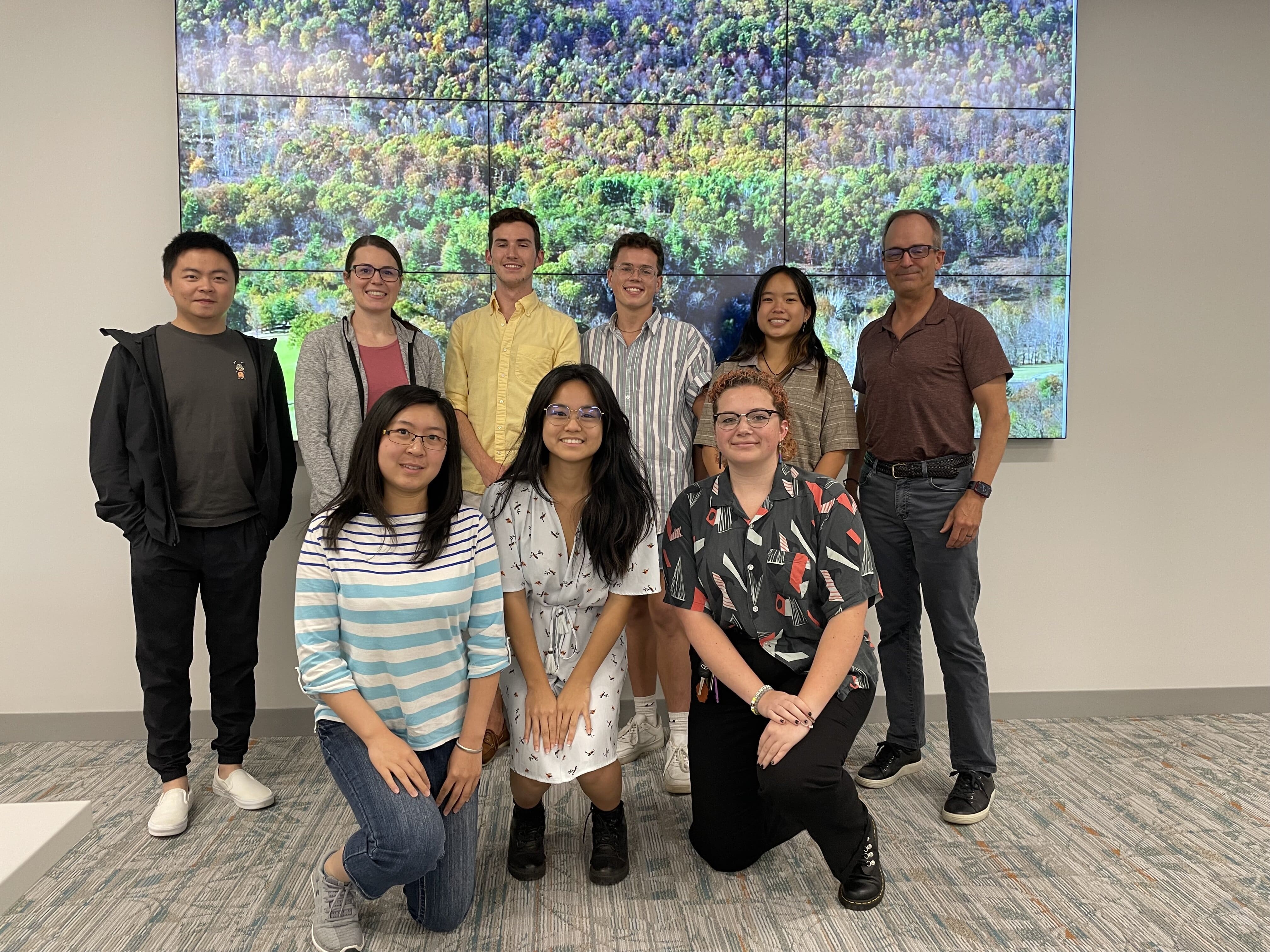
A special thanks to all the previous undergraduate student team members:
- Frances Marie Panday, Advanced Data Analyst at MDE
- Michael Howerton, Research Fellow at EPA
- Katelyn Kopp, Environmental Analyst at Potomac-Hudson Engineering
- Jarrett James, Sustainability Senior Associate at PwC
- Maddy Albee, Energy & Sustainability Specialist at ICF
- Amelia Patterson, Environmental Engineer at EPA
- Janna Chapman, Faculty Specialist at UMD GEOG department
- Rieley Auger, Program Manager at Global Land Programme
- Camille Hoffman Delett, Biological Science Technician at USDA
- Jordan Nicolette, GIS Analyst and Biologist at USDA Animal and Plant Health Inspection Service (APHIS)
- Hilary Sandborn, PhD Student UNC Chapel Hill
Accomplishments
- Related Publications
- Year 1 Project Summary
- AGU 2020, Science and Society Session, ePoster
- AGU 2021, Accessing Broader User Communities for Earth Observations of Terrestrial Systems Session, Oral Presentation:
- Campus Forest Carbon Project Technical Guidance Document
- Peer-Reviewed Offset Protocol for U.S. Forest Projects 1.0
- In the News
- 2024
- 2022
- 2020
- Awards and Honors
- 2020
- Annual Meeting Outstanding Student Presentation Award, American Geophysical Union
- Department of Geographical Sciences Undergraduate Independent Research Award
- 2021
- Department of Geographical Sciences Undergraduate Independent Research Award
- 2022
- Environmental Science and Policy Program 25th Anniversary Celebration - Best Research Poster, Katelyn Kopp
.
- Environmental Science and Policy Program 25th Anniversary Celebration - Best Research Poster, Katelyn Kopp
- 2020