

UMD Study: Climate Has Unequal Impacts on Different Tropical Forests
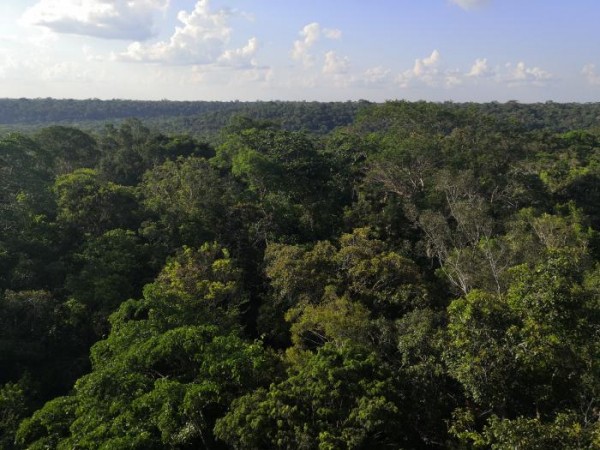
Geographical sciences researchers show warmer temperatures and drought have worse impacts on some areas than others.
A new study in Nature led by geographical scientists at the University of Maryland helps paint a clearer picture of how warmer temperatures and drier conditions uniquely impact tropical forests, the parts of the planet that are best suited to slow global warming.
Looking at lowland intact tropical forests in the Amazon, Congo Basin and Southeast Asia over the course of the year 2020, the researchers found that temperature increases and low levels of rainfall did not have a blanket effect across all of the areas they observed. Rather, the degree to which these climate changes impacted the forests depended on the unique composition of each—a novel finding given existing research on the topic.
“Tropical forests store 40% of the global forest carbon, but the extent to which climate controls tropical forest biomass remains debated because previous studies have reported contrasting results across regions,” said Matheus Henrique Nunes, the lead author of the study and an assistant research professor in the Department of Geographical Sciences (GEOG). “Previous studies have widely shown that the effects of lack of water availability, or droughts, have negative impacts on forest biomass, but there are studies also showing that droughts do not matter or can even increase forest biomass. The effects of temperature are the same.”
The researchers’ latest study suggests that the driving force of these historically conflicting findings is the fact that tropical forests are not all the same—their composition, structure and evolutionary history vary tremendously across space—and those differences matter. Nunes says that some Amazonian forests, for example, can have very tall trees above 80 meters in height, while other forests in the Amazon look more like savannas growing on sandy soils.
“Our results show that the effects of climate really depend on the local environmental factors like soil and topography, and that tropical forests can have very different and contrasting responses to increases in temperature and droughts,” he said.
According to the study, temperature increases had the most negative effect on forests in the Congo Basin, causing a decrease of 27.6 Mg/ha in the Congo Basin forests’ aboveground biomass, the metric used to measure forests’ carbon stores. On the flip side, forests in the Amazon and Southeast Asia only saw aboveground biomass decreases of 11 Mg/ha and 0.1 Mg/ha respectively.
The researchers also found that longer dry seasons and drought events had the strongest negative effect in the forests of Southeast Asia and in the relatively arid parts of the Amazon, such as southern Amazonia.
However, the very wet regions of the Amazon, such as northwestern Amazonia, and the Congo Basin did not suffer from stronger droughts—and even responded positively to drier conditions.
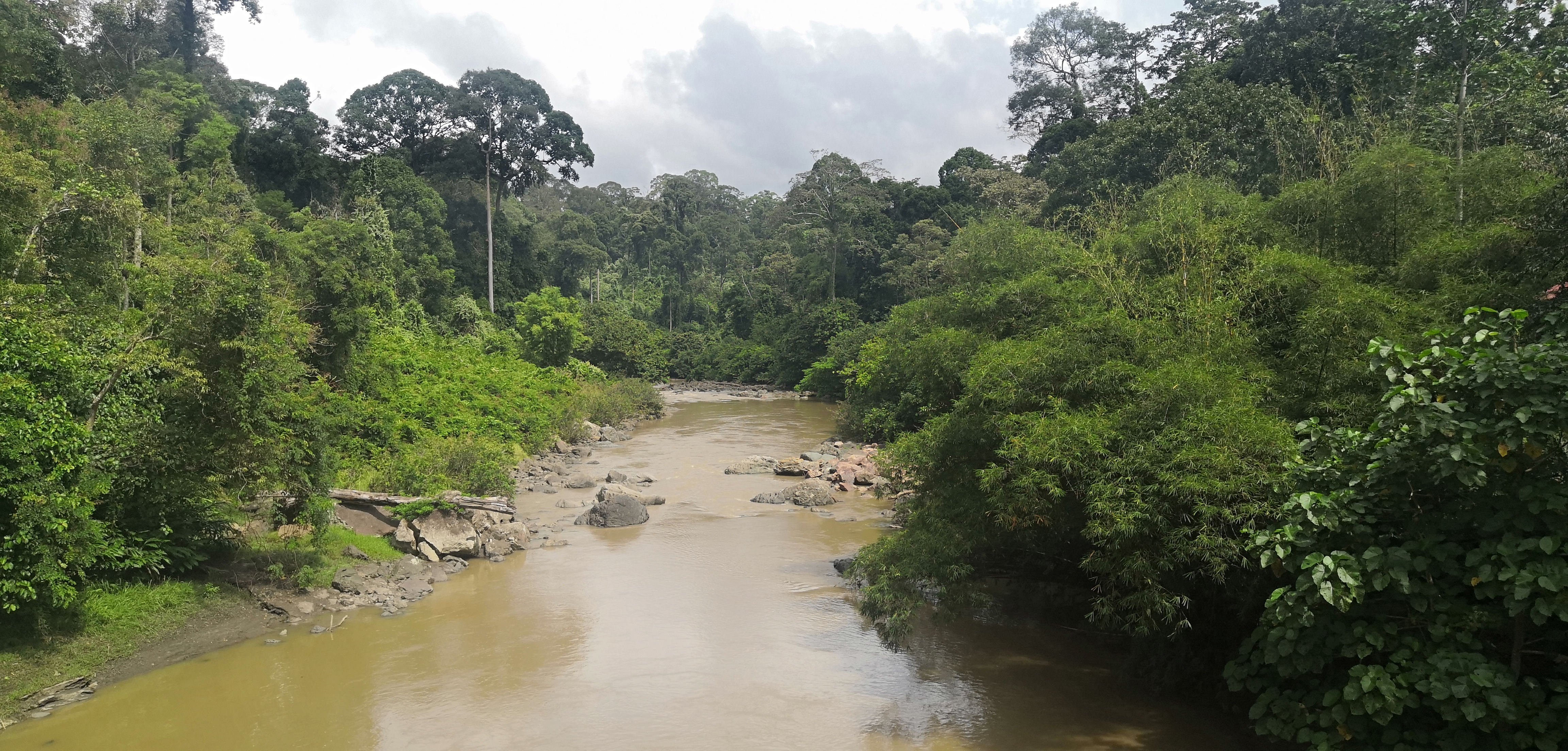
The Danum river, near the lodge of the Danum Valley Conservation Area
“It is no longer enough to ask whether forests become warmer or drier. We also need to know the environmental context in which those changes occur,” said Nunes. “That means preserving forests remains essential, but preserving them alone does not guarantee they will continue storing carbon equally well. Some forests are more resilient than we thought, and others are more vulnerable than we thought, even if they remain intact.”
The researchers also looked at how the forests were impacted by storms with lightning and strong winds, and found that the forests that suffered most were those that were taller than 60 meters. Forests with giant trees, like those in Sumatra, could suffer the most from potential increases in storms.
“This study addressed a high-level scientific question: how forest biomass stocking changes in undisturbed conditions across different biomes,” said co-author Adrián Pascual, GEOG associate research professor. “From my point of view, the study excels at incorporating interesting factors, and their interactions, that model the distribution and accumulation of forest carbon biomass. Local topography, lightning frequency and particularly the interaction between aridity and drought—frequently ignored in other global studies—significantly contributed to explaining the forest carbon biomass dynamics of undisturbed tropical forests.”
All of these findings were made possible by the Global Ecosystem Dynamics Investigation (GEDI), an instrument that measures forests in 3D using a laser measurement method called Light Detection and Ranging, aka lidar.
The field plots observed in previous studies cover less than 0.001% of tropical forests, but GEDI allowed the researchers to analyze environmental controls consistently across nearly all intact tropical forests.
Having taken 16 million forest measurements, the researchers’ study is one of the largest analyses of the environmental impacts on tropical forest biomass ever conducted.
“By revealing the complex environmental controls on tropical forest carbon storage, this study provides a stronger scientific foundation for predicting how these ecosystems may respond to climate change,” said co-author and GEOG Distinguished University Professor Ralph Dubayah, GEDI’s principal investigator. “As one of a growing number of high-impact studies enabled by NASA's GEDI mission, led by the University of Maryland and NASA Goddard Space Flight Center, this research highlights the power of NASA's investment in Earth observations to support gold-standard science and translate discovery into actionable knowledge. Our results can help a wide variety of stakeholders, from decision makers to local ecologists and conservationists, identify forests that are especially vulnerable or resilient and make better-informed conservation and resource management decisions.”
Paper: Nunes, M. H., Muller-Landau, H. C., Görgens, E. B., Pascual, A., & Dubayah, R. (2026). Heterogeneous climatic controls on tropical-forest biomass. Nature. https://doi.org/10.1038/s41586-026-10880-2
All photos by Matheus Henrique Nunes
This article was written by Rachael Grahame and originally published on the College of Behavioral & Social Sciences' website.
Published on Wed, 08/12/2026 - 11:26