

New Study Calls for Legal Protection Around Indigenous Lands to Safeguard the Amazon
Research shows that Indigenous Lands remain highly effective at protecting forests, but surrounding landscapes need stronger legal safeguards to curb deforestation.
A recent international study published in Nature Sustainability, co-authored by researchers from the Department of Geographical Sciences, finds that while Indigenous Lands (ILs) in the Brazilian Amazon continue to serve as powerful barriers against deforestation, the forests surrounding them remain increasingly vulnerable to illegal land occupation and resource exploitation. The researchers argue that extending legal protection to buffer zones around ILs is essential to preserving biodiversity, protecting Indigenous communities and maintaining the Amazon’s critical role in regulating the global climate.
The study focuses on the Vale do Javari Indigenous Land in western Amazonas, a vast protected territory located at the tri-border region of Brazil, Colombia and Peru. Covering approximately 85,500 square kilometers, an area larger than Austria, it is home to the world's largest concentration of Indigenous peoples living in voluntary isolation. The territory drew international attention in 2022 following the murders of British journalist Dom Phillips, who was reporting for The Guardian, and Bruno Pereira, an indigenist and employee of FUNAI (Brazil's National Indigenous Peoples Foundation), by illegal fishermen while documenting environmental crimes in the region.
The researchers based their analyses on deforestation data from Brazil's PRODES monitoring program together with land-cover information from the MapBiomas platform to compare annual deforestation inside the Indigenous Land with surrounding areas extending up to 200 kilometers beyond its borders. Their analysis revealed that, in 2022, deforestation within the 200-kilometer surrounding zone was 187.5 times greater than inside the Indigenous territory itself. Although deforestation declined in 2023 and 2024, forest clearing in surrounding areas remained well above historical levels.
The findings add to decades of scientific evidence showing that Indigenous territories are among the most effective conservation strategies for tropical forests. However, the researchers found that legal protections currently end at territorial boundaries, leaving adjacent forests vulnerable to activities that can gradually undermine the ecological integrity of protected lands.
The study was led by Gabriel de Oliveira of the University of South Alabama and involved collaborators from institutions in Brazil and abroad. Among them were André Lima and Matheus Henrique Nunes, both assistant research professors in the Department of Geographical Sciences.
“A sense of belonging fundamentally shapes how people relate to the territory they inhabit; a space becomes a place, a place that exists only through a context of coexistence,” Lima said. “This helps explain why Indigenous Lands are such effective barriers against deforestation: Indigenous Peoples belong to these territories.”
To address the vulnerability of forests surrounding Indigenous territories, the authors propose extending to Indigenous territories the same legal concept of buffer zones already used for many protected areas in Brazil, including national parks and extractive reserves. These zones regulate human activities in surrounding landscapes to reduce external pressures on protected ecosystems. Applying a similar framework to Indigenous territories would help prevent illegal occupation of public lands and reduce the expansion of activities that threaten both biodiversity and Indigenous livelihoods.
Beyond protecting forests, the study underscores the broader ecological and cultural importance of Indigenous territories. Vale do Javari is home to numerous Indigenous peoples, including at least 14 groups living in voluntary isolation, and five Indigenous Peoples who maintain substantial contact with the surrounding society. Preserving these territories is critical not only for conserving biodiversity and storing carbon, but also for safeguarding Indigenous rights, cultures and traditional ways of life.
The researchers note that stronger enforcement will be just as important as new legal protections. Because government agencies often face limited budgets and staffing, they recommend prioritizing monitoring and law enforcement in areas adjacent to Indigenous territories, where preventing new illegal occupations can substantially reduce future deforestation.
“As researchers, our role is to highlight the threats facing these forest peoples in order to urge the Brazilian government to establish a stronger presence in the Amazon region,” Lima said. “Ultimately, protecting these territories means safeguarding the way of life of Indigenous and other traditional communities while preserving the full range of ecosystem services the Amazon rainforest provides globally.”
Paper: de Oliveira, G., Koster, E., Marubo, B., Laureto, L. M. O., Nobre, C. A., Funatsu, B. M., Geber-Corrêa, R., Dias-Júnior, C. Q., Pugley, D. D., Pierrat, Z. A., Heredia-R, M., Morton, D. C., Hoffman-Hall, A., Maure, L., Zhuang, Q., Krause, T., Coutinho, T. C., Mataveli, G., Brunsell, N. A., Ziccardi, L. G., Moise, I. K., Biggs, T., Stark, S. C., Ribeiro, J. G. S., Carniatto, I., Bispo, P. C., Godoy Junior, P. C., Wagner, F. H., Gomes, H. B., Mergen, A., De Sales, F., Webler, A. D., Sutherlin, C. E., Santos, C. A. G., Cunha, A. C., Machado, W. B., Bezerra, K. F. S., Aguiar, E. A. L. S. P., Santos, C. A. C., Manzione, R. L., Vergopolan, N., Brown, J. C., Melo, D. B., Maeda, E. E., Cabral Júnior, J. B., Cunha, H. F. A., Lima, A., Abascal, A., Chaves, M. E. D., Lima, J. A., Dalagnol, R., Fuchs, V. B., Nunes, M. H., … Artaxo, P. (2026). Spiralling frontier threats in Indigenous Amazonia. Nature Sustainability. https://doi.org/10.1038/s41893-026-01874-z
This article was adapted from a press release published by Agência Bori. The original Portuguese release can be found on the Agência Bori website.
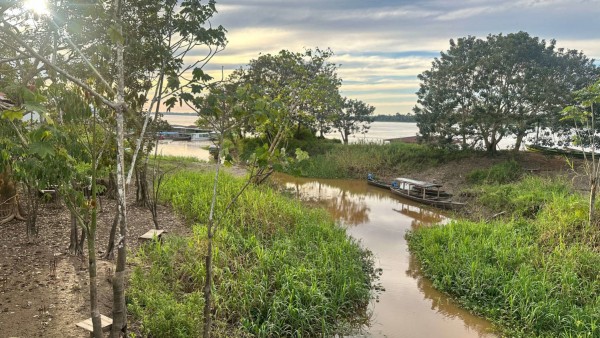
Photo of Amazon riverbank by researchers Gabriel de Oliveira and Erin Koster via Agência Bori
Published on Fri, 07/31/2026 - 09:28