
UMD College of Behavorial & Social Sciences UMD College of Behavorial & Social Sciences
MENU

Topbar Menu

  • About Us
  • People
  • Alumni and Giving
  • Undergraduate
    • Prospective Students
    • Courses & Facilities
    • Advising
    • Special Programs
    • Graduation
    • Geography Club
  • Graduate
    • Prospective Ph.D. Students
    • Graduate Courses
    • Graduate Student Publications
    • Graduate Student Awards
    • Graduate Students
    • Master of Science and Graduate Certificate Programs
    • Combined BS/MS Program
  • Research
    • Research Areas
      • Geospatial-Information Science and Remote Sensing
      • Human Dimensions of Global Change
      • Land Cover and Land Use Change
      • Carbon, Vegetation Dynamics and Landscape-Scale Processes
    • Centers
      • Center for Geospatial Information Science
      • International Center for Innovation in Geospatial Analytics & Earth Observation
  • High School Hub
    • Program Overview
    • High School Awards
    • High School Internship Program
    • GIS Day
    • Request a Geographer
  • Resources
    • Graduate Student Organization
    • Student Life
    • Graduate School
    • Responsible Conduct of Research
    • Emergency Preparedness
    • Job Opportunities
    • Graduation
Search

Main navigation

  • Undergraduate
    • Prospective Students
    • Courses & Facilities
    • Advising
    • Special Programs
    • Graduation
    • Geography Club
  • Graduate
    • Prospective Ph.D. Students
    • Graduate Courses
    • Graduate Student Publications
    • Graduate Student Awards
    • Graduate Students
    • Master of Science and Graduate Certificate Programs
    • Combined BS/MS Program
  • Research
    • Research Areas
      • Geospatial-Information Science and Remote Sensing
      • Human Dimensions of Global Change
      • Land Cover and Land Use Change
      • Carbon, Vegetation Dynamics and Landscape-Scale Processes
    • Centers
      • Center for Geospatial Information Science
      • International Center for Innovation in Geospatial Analytics & Earth Observation
  • High School Hub
    • Program Overview
    • High School Awards
    • High School Internship Program
    • GIS Day
    • Request a Geographer
  • Resources
    • Graduate Student Organization
    • Student Life
    • Graduate School
    • Responsible Conduct of Research
    • Emergency Preparedness
    • Job Opportunities
    • Graduation
  • About Us
  • People
  • Alumni and History
  • Diversity

Search our site:

Associate Professor Taylor Oshan, Doctoral Student Honored at AAG Annual Meeting

Breadcrumb

  • Home
  • Featured Content
  • Associate Professor Taylor Oshan, Doctoral Student Honored At AAG Annual Meeting
A medium shot of a man with a beard, wearing a black quarter-zip sweater and an AAG 2026 conference badge, smiling and holding a wooden plaque. The plaque reads, "The American Association of Geographers Spatial Analysis and Modeling Specialty Group, 2026 Emerging Scholar Award, Dr. Taylor Oshan, University of Maryland." He is seated in a wheelchair in what appears to be a conference room.

Oshan earned national recognition for his work in spatial analysis, and Ph.D student Victor Irekponor took top honors at the same conference.

Associate Professor Taylor Oshan received the 2026 Emerging Scholar Award from the Spatial Analysis and Modeling Specialty Group at the American Association of Geographers (AAG) Annual Meeting, which recognizes early-career scholars making significant contributions to the field.

At the same conference, doctoral student Victor Irekponor won first place in the John Odland Student Paper Competition, also organized by the group. It marks the second consecutive year one of Oshan’s students has won the award; Mengyu Liao took first place in 2025.

Oshan said the award reflects his work on advancing both the theory and practice of spatial analysis.

“I think it recognizes a mix of things: development of technical aspects of multiscale modeling methods, conceptualization of spatial scale and how to infer it, and open source software tools to make advanced spatial analysis more accessible,” he said.

He is particularly interested in addressing uncertainty in how researchers define and measure spatial scale.

“Scale or equivalently the concepts of neighborhoods, proximity or regions are often at the core of spatially-oriented social science, but uncertainty about the associated assumptions are rarely grappled with” he said. “I’m also interested in how generative AI can make spatial analysis methods more accessible.”
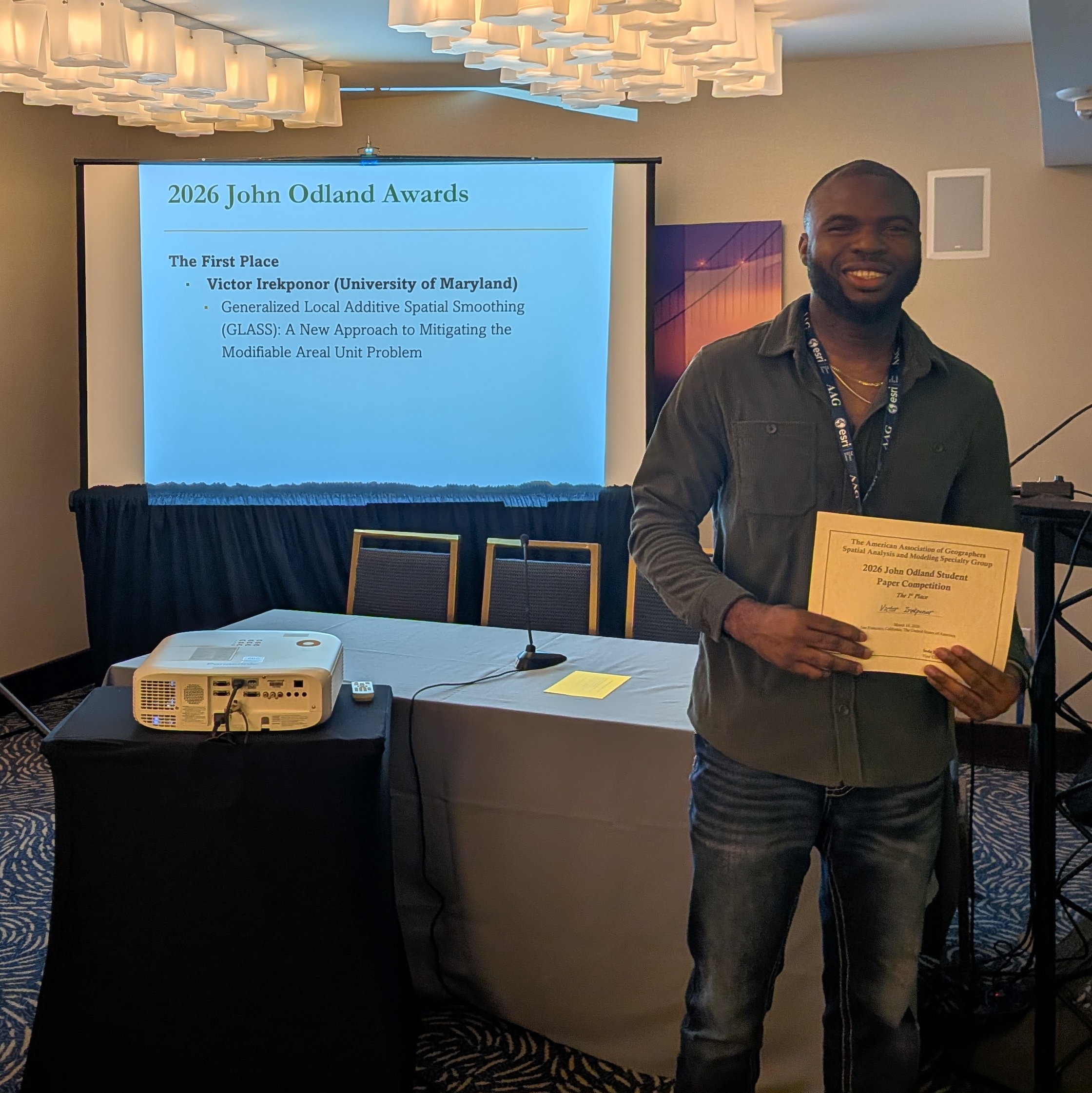
A smiling man stands in a conference room holding a certificate for the 2026 John Odland Student Paper Competition (1st Place). He is wearing a grey button-down shirt, jeans, and an ESRI/AAG lanyard. Behind him, a projector screen displays his name, Victor Irekponor (University of Maryland), and the title of his winning paper: Ph.D. student Victor Irekponor accepts the 2026 Odland Student Paper Award at the AAG conference.

Irekponor’s award-winning paper introduces a new local regression method designed to address the “change of support” problem in spatial analysis. Traditional approaches often rely on aggregating data, which can introduce bias tied to the Modifiable Areal Unit Problem.

His method, called Generalized Local Additive Spatial Smoothing (GLASS), integrates spatial support directly into the modeling process using data-driven techniques, improving accuracy while preserving fine-scale patterns.

“The study shows how aggregation distorts local relationships and demonstrates how GLASS can improve inference by aligning spatial supports within the modeling process in a data-driven way, rather than relying on prior aggregation,” Irekponor said.

The project combines simulation experiments and a real-world case study to show how the method reduces bias while maintaining fine-scale spatial structure. The work is currently under review in a top journal and forms a central chapter of his dissertation.

Oshan said his approach to mentoring emphasizes both deep engagement with the field’s foundations and hands-on technical development.

“Conceptually, I encourage my students to focus on contributing first and foremost to core disciplinary concerns,” he said. "Technically, I encourage my students to code up solutions themselves and use logical experiments and edge cases to diagnose issues and confirm their understanding."

Irekponor said working with Oshan and the SMASH research group helped shape the project’s direction. As a next step, he plans to apply the GLASS framework to study how features of the built environment influence gentrification in the D.C. Metro area, particularly when data are collected at different spatial scales.

Main image: Associate Professor Taylor Oshan receives the 2026 Emerging Scholar Award from the Spatial Analysis and Modeling Specialty Group at the AAG Annual Meeting, March 17 to 21 in San Francisco. All photos courtesy of Oshan

Published on Wed, 04/08/2026 - 09:49

College of Behavioral & Social Sciences
  • Facebook
  • Twitter
  • Instagram
  • YouTube
  • LinkedIn
  • Zenfolio

Department of Geographical Sciences

2181 Samuel J. LeFrak Hall, 7251 Preinkert Drive,
University of Maryland, College Park, MD 20742
Phone: 301-405-4050

Subscribe to Our Newsletter

Contact Us

Links
  • UMD Land Acknowledgement
  • UMD Staff Directory
  • Give to GEOG
  • UMD Web Accessibility
  • Alumni
© 2026 College of Behavioral & Social Sciences. All Rights Reserved.
Login