

Chair's Blog
What Doesn’t Kill Us …
_1.jpeg)
For several years now, I have been, in turn, puzzled by, incredulous about, and despondent over the grievances brought forth by people younger than me (which, in all honesty, is a LOT of people, especially in a University setting). My internal monologue frequently starts with “REALLY? THAT is what worries you?” And increasingly, I have started wondering whether that reaction says as much about me as it does about them.
Now, let me make this clear. Most frequently, people bring very serious issues to me, and those constitute the majority of things I deal with as the Chair. That’s a whole different category — and definitely not the subject of this blog.
Back to the subject of this blog …
It struck me recently, when I was looking at a pain chart in a hospital, what an incredibly subjective way it is to measure pain. How does my 7 compare to your 7? I found myself wondering how much our idea of a “10” is shaped by the worst pain we have experienced before. Depending on one's life experience, that reference point could range from a scraped knee to drug-free childbirth to a horrible accident with a chainsaw to <let your imagination run free here> ...
And that’s when something else struck me.
An injustice that looks like a bare “3” on the 1-to-10 scale to me might look very different to someone with a different range of experiences in that domain. We, as parents, mentors, and society as a whole, have worked very hard to make sure that the younger generation has a better and safer life than we did. And perhaps the fact that young people are concerned about things we think of as “minor” is a sign of progress. I emphatically do not want young women to go through my experiences in the workplace (pre-UMD). There are plenty of things we tolerated in the past that absolutely should not be used as character-building exercises for the next generation.
The flip side of the same coin, however, is that in our effort to create a more protected environment, I wonder if we have also removed too many opportunities for young people to discover that they can deal with difficulty. Sometimes you need to struggle with something, and perhaps even fail at it, to figure out that you actually can deal with it.
And while I am not advocating for making a parkour course a required part of education at UMD, I do think it is our responsibility to broaden our students’ life experiences, challenge them in the classroom, and give them opportunities to overcome difficulties in a productive and supportive environment.
I don’t want us to recreate the things that made previous generations "tough". Some of them were awful, and getting rid of them was progress. But I also don’t think removing every obstacle, every disappointment, or every uncomfortable experience from our students’ paths is the right way to go.
What doesn’t kill us doesn’t always make us stronger. But learning that we can get over obstacles probably does.
No actual parkour required.
Image: Adobe Stock
Published by Tatiana Loboda on Thur, 09/03/2026 - 13:01
University Degree: What Exactly Are We Paying For?
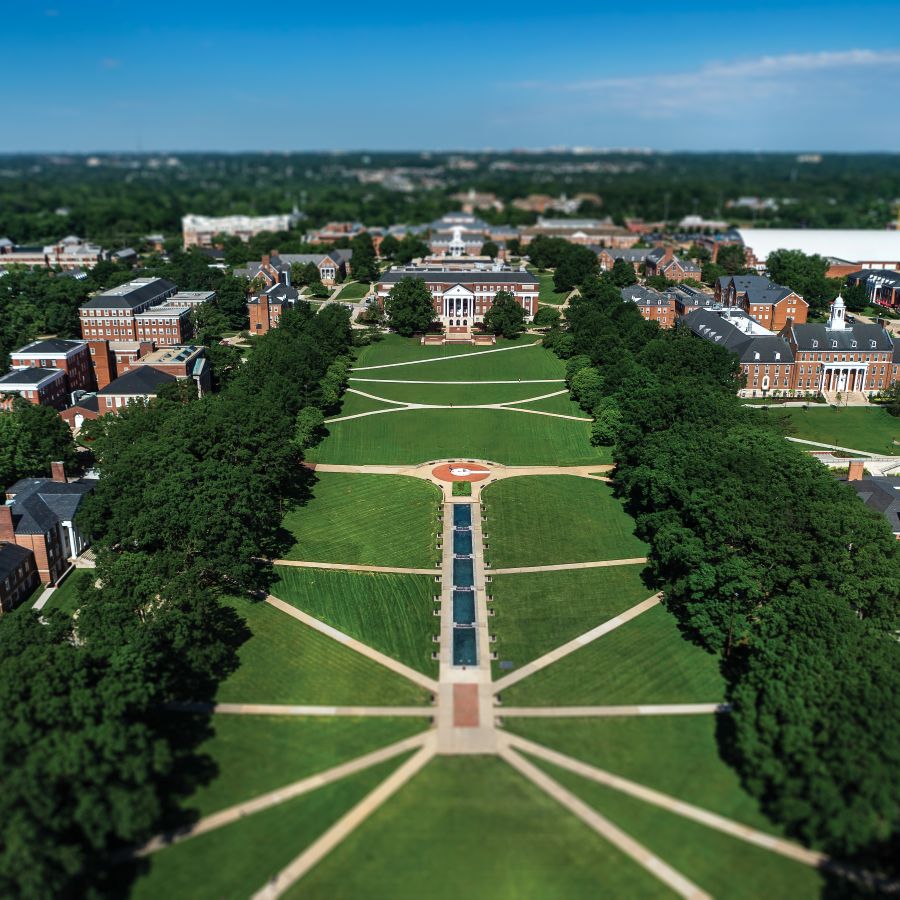 Aerial view of UMD's McKeldin Mall
It is fascinating that at a time of record-high educational attainment in the United States, there is such intense debate about the “worth” of education. Recent data from the US Census Bureau show that slightly more than 40% of women and 37% of men over the age of 25 hold at least a bachelor’s degree. And that fraction has been increasing from one generation to the next. So clearly, we have been valuing higher education all along. Why are we starting to doubt it now?
There are many reasons. But I would like to focus on one that we do not talk about enough. Allow me, just this once, to be blunt.
University degrees are no longer the realm of “special people.” Anyone willing to put in a reasonable amount of effort can be admitted to one of the many colleges and universities that offer undergraduate degrees. No, that does not mean anyone can get into any university. But there is a university somewhere for almost everyone.
And that is a good thing. We do not start life with equal access to resources or education. It makes sense that we would need different environments in which to thrive while pursuing higher education.
But here is the catch.
When something stops being rare, we begin to value it less. If anyone can have it, is it even worth having? Yes. Absolutely. Almost everyone has teeth too. And those who do not really miss them.
If everyone has a degree, then simply having one does not make you stand out. Showing up physically at a university and doing the absolute minimum required to obtain a diploma will not set you apart.
What does? Seeking opportunities. Learning actively. Building skills. Developing networks. Becoming genuinely good at something. That is the point. Did you want to “be the very best like no one ever was”? (That is a Pokémon reference for those who may have missed it.)
I also grow weary of the stereotype of professors in “ivory towers,” supposedly ignoring students or boring them to death. I work with a small department of extraordinarily dedicated faculty who pour their hearts into both science and teaching. Pouring your heart into teaching does not mean performing stand-up comedy or choreographed dance routines in the classroom. It means distilling decades, sometimes centuries, of accumulated knowledge. Sometimes it means giving students a glimpse of ideas that do not even exist yet.
And yet, far too often, students do not even look up from their phones.
Admission to a university is like receiving a ticket for a potentially amazing journey. Yes, you paid for the ticket. But the seating is unassigned, and no one can force you to get on board. If you choose not to, you will miss the trip entirely.
So is the price worth it? That depends. Are you simply going to have a degree, or are you going to use it?
You can receive an outstanding education at almost any university if you truly want to learn. Conversely, if you attend Harvard but spend 90 percent of your time looking at your phone, you will not.
Education is worth it. But universities cannot force it upon you. You have to be a willing participant. More than that, you have to be the engine of your own educational success. Be the little engine that could.
Because your future depends on it. And so does everyone else’s.
Published by Tatiana Loboda on Fri, 03/06/2026 - 10:30
AI: It’s Already Here — I Hope We Can Be Friends
 Image created with Canva.com
Could I have picked a more polarizing subject? Absolutely. But this one is good enough. I don’t know how you feel about AI, but I’m pretty sure your feelings are strong. I’d guess that the reason for this is that AI is an immensely powerful tool — for good and for evil. Never have we come this close to Orwellian 1984-type capabilities on the one hand, and to “boldly go[ing] where no man [or anyone else] has gone before” on the other. Which direction will it go? Most likely, both.
It’s up to us — people — to decide what we use this power for.
I remember the early 2000s, when GPS tracking technology emerged and started taking over the world. We, geographers, raised concerns about what we called geo-slavery. The idea was simple: once the technology became widely available, it would be used to track and control people. Did that happen? Unquestionably. GPS is still used to stalk and control people. And yet, it’s also hard to imagine life without GPS now.
AI is more powerful, and the potential for both good and bad is much larger. That’s why I’m glad to see so many people engaged in the broader conversation. I don’t think AI is going away. And I, for one, am happy about it (yes — once the computers take over the world, you can tell me “told you so”).
In the meantime, I’m looking for ways to get AI to help me make my workday more productive and a bit more interesting. I collaborate with several AI agents, and I find them extremely helpful. Do I think my collaborators are always right? Nope. Do I take everything they say for granted? Definitely not. Do they provide useful insights and helpful arguments? They do — especially when I ask them to play devil’s advocate.
But that’s on me. I need to ask for sanity checks. I need to decide whether the arguments they present actually withstand scrutiny. I need to check whether they interpreted the information they pulled from web sources correctly. I need to provide proper guidance to get a good result. Don’t be mad at AI when you get a garbage response. Keep in mind that it was we, people, who put the initial garbage into the information pool.
AI, at least for now, is a very bright early-career collaborator who is genuinely trying to help. Instead of fighting against AI, I strongly advocate engaging it — as much as possible — in our teaching, research, and yes, even service.
I would much rather see students using AI to build something interesting in an introductory programming course than proudly printing “HelLo world./” I would rather researchers run manuscripts through AI before submission to look for weak spots in their arguments. And I would much rather read an AI-edited paper than struggle through awkward grammatical structures from authors whose first language is not English (I am one — I would know). I would also much rather let AI draft policies for me — especially if I can ask it to make them consistent with a hundred-page university policy document. AI can and will do this gladly.
But when I put my name on the final version, it’s still my job to make sure it says what I mean. So I’m learning how to collaborate with AI, and I’m genuinely enjoying the process. I push it to its limits (it’s funny how close those limits sometimes are). And because of that collaboration, I can accomplish more and feel happy with the quality of the outcome.
AI will keep getting better. Human intelligence needs a little more training.
Published by Tatiana Loboda on Fri, 01/30/2026 - 16:05
American Geography: What, Where, Why on Earth?
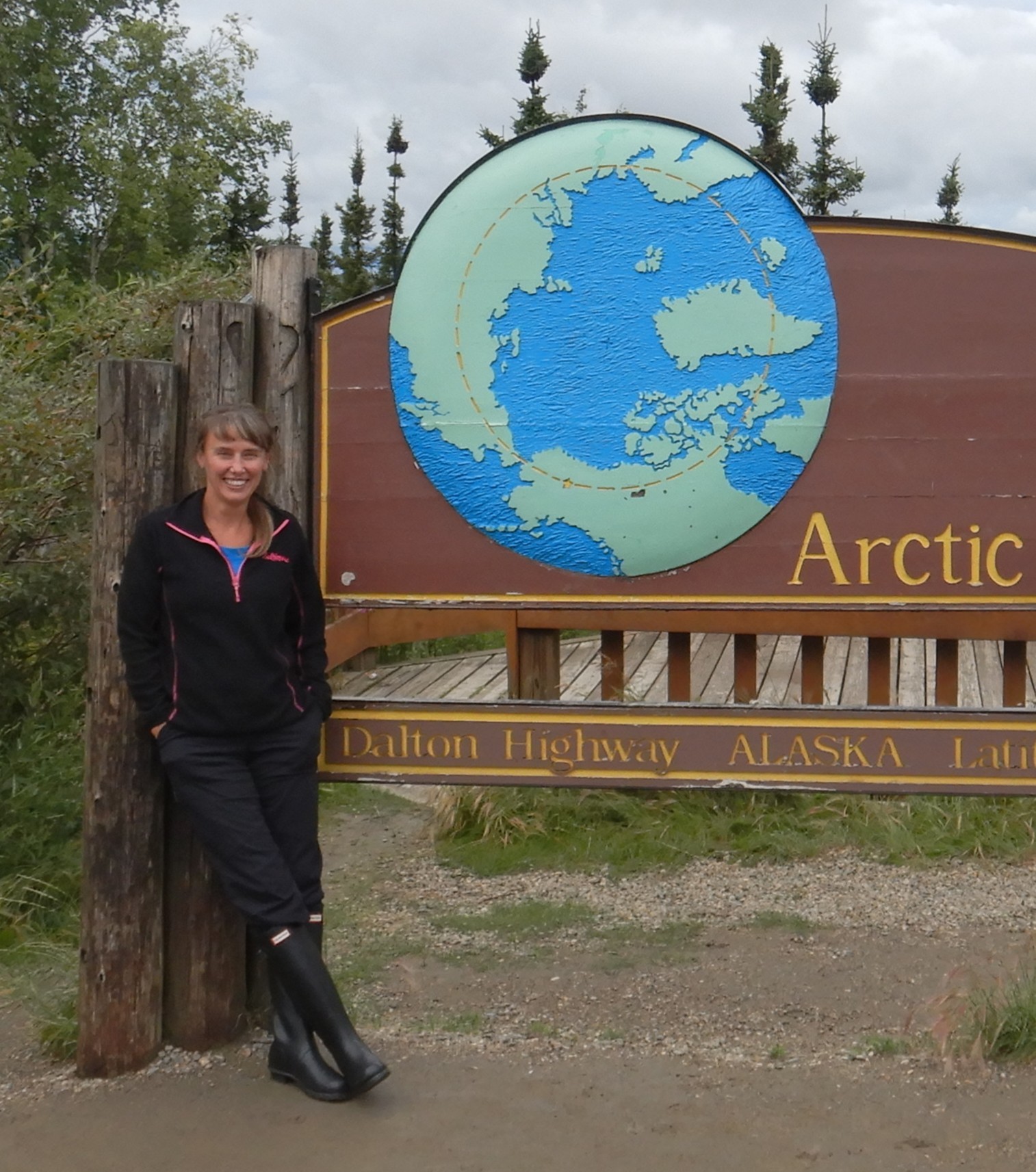 On the way to tundra fieldwork, Tatiana Loboda takes a break to pose by the Arctic Circle sign on Alaska’s Dalton Highway in 2018.
What happened to geography? When did “discovering the world” get boring and unappealing? Where did wanderlust go? Why is introducing oneself as a geographer so intensely uncomfortable that one immediately feels the urge to explain?
We could all come up with a long list of reasons. But I really think it boils down to two big ones.
First: information overload. We are so very fortunate to live in a world where you can visit—at least virtually—any country on Earth, day or night, with just a few clicks on your keyboard. We can.
But we rarely do.
With so many apps competing for our eyeballs, and with attention spans getting shorter by the day, natural and cultural wonders don’t stand much of a chance. This isn’t exactly a shocking realization. I’m not going to pretend I’m saying something new here.
But information overload isn’t the whole story.
The second reason is harder to talk about. It’s the gradual, and very intentional, removal of geographical knowledge—and even awareness of geography as a discipline—from American society. Chester Finn, a senior fellow at the Fordham Institute, once referred to geography as “the unloved stepchild of American education.” I’d actually take it a step further.
Geography isn’t Cinderella. Geography is Rapunzel—locked far away in an academic tower, surrounded by thick, nearly impassable brambles of ignorance.
Geography gets discovered by people who are bored with the available options, or by those who are genuinely, hopelessly lost. And then, of course, there are the knights (of all genders) who arrive from faraway lands to join Rapunzel’s round table.
I’m getting carried away with mythology, but you get the point. American geography relies heavily on foreign talent. We are fortunate because of it. But it’s still worth asking: why does that matter?
Because once you actually stop and think about it, it becomes surprisingly hard to name an economic or societal endeavor that doesn’t require a solid understanding of spatial linkages. Supply chains? Workforce availability? Exposure to harmful—or beneficial—conditions? School redistricting?
Try it yourself. It’s harder than it sounds.
I’m sure that two or three hours later I might come up with an exception. Until then, nearly everything depends on geographic knowledge overlapping with other kinds of expertise.
Geography—the study of spatial linkages in natural and societal settings—is central to how the world works. What happens where. Why it happens there. And why that matters elsewhere.
In many ways, we still do what the intrepid explorers of the past did. We describe what Earth looks like, where it is changing the fastest, and why things are the way they are in different places.
We just use cooler tools. Satellite data. Digital platforms. Increasingly, artificial intelligence. But we still go to faraway, remote, and sometimes uninhabited places.
Geography is still about seeing the world—how it works, how it’s changing, and how our lives are entangled with those changes.
So yes—join geography. See the world.
And yes, in a good way.
Published by Tatiana Loboda on Wed, 01/14/2026 - 9:35