

ENSP-Remote Sensing Student Named Truman Scholarship Finalist
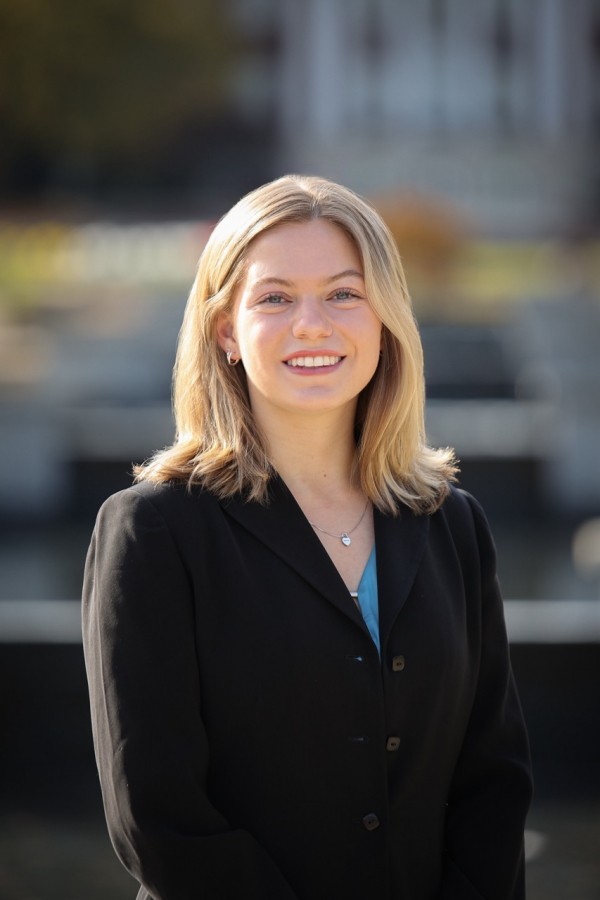
Junior Vivian Maneval is one of the nation’s top students recognized by the Truman Scholarship for her leadership, academic excellence and commitment to a career in public service.
Vivian Maneval, an Environmental Science and Policy major with a remote sensing minor, has been named a finalist for the Truman Scholarship, a highly competitive national award supporting students who plan to pursue graduate study and careers in public service.
Selected from 781 nominees nationwide, Maneval is among 198 students advancing to the interview stage, scheduled for March and early April. She is joined by Environmental Politics and Policy student Michelle Wang as the only two UMD students to move forward. The 2026 Truman Scholars will be announced on April 24.
A Crownsville native who grew up along the Severn River in the Chesapeake Bay, Maneval has centered her academic and professional work on strengthening coastal resilience and advancing global conservation goals. She recently completed a six-month internship with the High Ambition Coalition for Nature and People, a partnership of 124 countries working to protect 30 percent of the world’s land and ocean by 2030, and currently serves as a content writing intern with the UMD Office of Sustainability.
Below, she shares how her coastal roots, geospatial training and international experiences have shaped her path.
What first drew you to marine and coastal geography, and how has your experience in the GEOG program shaped the way you think about environmental challenges?
Growing up on the water, I watched water quality change, floods become more frequent and shoreline erosion occur over time. These changes right outside of my home made me aware of the urgent need for environmental protection, especially coastal resilience.
I see sea level rise as one of the most pressing global challenges, with the potential to displace millions and threaten critical infrastructure and ecosystems. Taking courses like “Earth Observation Science” and “GIS and Spatial Analysis” in the GEOG department has shown me how we can map these impacts over time and model future risk. The ENSP-GEOG program has helped me connect my environmental interests with these tools, which will undoubtedly be essential in my future career.
What led you to pursue a minor in remote sensing?
After my first semester of freshman year, I traveled to Vietnam’s Mekong Delta for a short-term Climate-Resilient Development program. While studying aquaculture expansion and mangrove loss in Cà Mau, I was intrigued by satellite imagery’s ability to reveal land-use change at a scale impossible to observe on the ground. Remote sensing felt like a powerful way to make environmental change visible and measurable, and pursuing the minor has allowed me to build technical skills that bridge my interests in scientific research and real-world decision-making.
How did you feel when you learned you were selected as a Truman Scholarship finalist, and what does this recognition mean to you personally and professionally?
I was so surprised to be selected! There are so many incredibly accomplished people on the list of finalists, and I feel honored to be among them. Personally, the recognition is a reminder of the impact I hope to make in my career and what I’ve accomplished up to this point.
It was also special to be selected alongside my fellow Environmental Science and Policy major, Michelle Wang, whose commitment to environmental justice I really admire. As the only two students selected from UMD to move on to the final stages of the Scholarship, I am proud that we can represent the ENSP program in this national recognition.
As a finalist for the Truman Scholarship, you’ve clearly demonstrated a commitment to public service. What issue or community motivates your work most, and why?
I’m most motivated by communities on the frontlines of climate change, especially those lacking financial resources or political support to adapt easily. During my recent internship with the High Ambition Coalition for Nature and People, I helped support a platform connecting countries with technical and financial assistance to implement conservation goals. That experience reinforced for me that adequate and accessible financing is often the missing piece in turning environmental commitments into real action.
Most importantly, I believe that everyone deserves to live in a community free of harmful environmental impacts and to experience nature fully and safely. Preserving ecosystems for future generations drives me to stay in public service, as I hope for environmental challenges to be treated as pressing priorities that require meaningful resources and action.
What courses have deepened or refined your academic and career goals? Any GEOG class?
My two study abroad experiences, Climate-Resilient Development in Vietnam and Sustainable Ecosystems in New Zealand, have redefined my career goals. They broadened my perspective on how climate solutions require international cooperation, innovation and acknowledgement of local contexts.
Additionally, the Fellows Program seminar “Energy and Environmental Policy” with Ed Fendley was extremely impactful, helping me understand real barriers to policy implementation and where opportunities exist for significant environmental change.
What would be your ideal job once you graduate?
I would love to work with a global environmental nonprofit, think tank or multilateral organization focused on climate and biodiversity progress. I’m especially interested in positions that combine research with policy design, in service of protecting vulnerable populations worldwide through financing, mitigation and adaptation strategies.
Image courtesy of Vivian Maneval
Published on Mon, 03/02/2026 - 11:12