
UMD College of Behavorial & Social Sciences UMD College of Behavorial & Social Sciences
MENU

Topbar Menu

  • About Us
  • People
  • Alumni and Giving
  • Undergraduate
    • Prospective Students
    • Courses & Facilities
    • Advising
    • Special Programs
    • Graduation
    • Geography Club
  • Graduate
    • Prospective Ph.D. Students
    • Graduate Courses
    • Graduate Student Publications
    • Graduate Student Awards
    • Graduate Students
    • Master of Science and Graduate Certificate Programs
    • Combined BS/MS Program
  • Research
    • Research Areas
      • Geospatial-Information Science and Remote Sensing
      • Human Dimensions of Global Change
      • Land Cover and Land Use Change
      • Carbon, Vegetation Dynamics and Landscape-Scale Processes
    • Centers
      • Center for Geospatial Information Science
      • International Center for Innovation in Geospatial Analytics & Earth Observation
  • High School Hub
    • Program Overview
    • High School Awards
    • High School Internship Program
    • GIS Day
    • Request a Geographer
  • Resources
    • Graduate Student Organization
    • Student Life
    • Graduate School
    • Responsible Conduct of Research
    • Emergency Preparedness
    • Job Opportunities
    • Graduation
Search

Main navigation

  • Undergraduate
    • Prospective Students
    • Courses & Facilities
    • Advising
    • Special Programs
    • Graduation
    • Geography Club
  • Graduate
    • Prospective Ph.D. Students
    • Graduate Courses
    • Graduate Student Publications
    • Graduate Student Awards
    • Graduate Students
    • Master of Science and Graduate Certificate Programs
    • Combined BS/MS Program
  • Research
    • Research Areas
      • Geospatial-Information Science and Remote Sensing
      • Human Dimensions of Global Change
      • Land Cover and Land Use Change
      • Carbon, Vegetation Dynamics and Landscape-Scale Processes
    • Centers
      • Center for Geospatial Information Science
      • International Center for Innovation in Geospatial Analytics & Earth Observation
  • High School Hub
    • Program Overview
    • High School Awards
    • High School Internship Program
    • GIS Day
    • Request a Geographer
  • Resources
    • Graduate Student Organization
    • Student Life
    • Graduate School
    • Responsible Conduct of Research
    • Emergency Preparedness
    • Job Opportunities
    • Graduation
  • About Us
  • People
  • Alumni and History
  • Diversity

Search our site:

Zhihao Wang Receives Outstanding Graduate Assistant Award
Breadcrumb

  • Home
  • Featured Content
  • Zhihao Wang Receives Outstanding Graduate Assistant Award
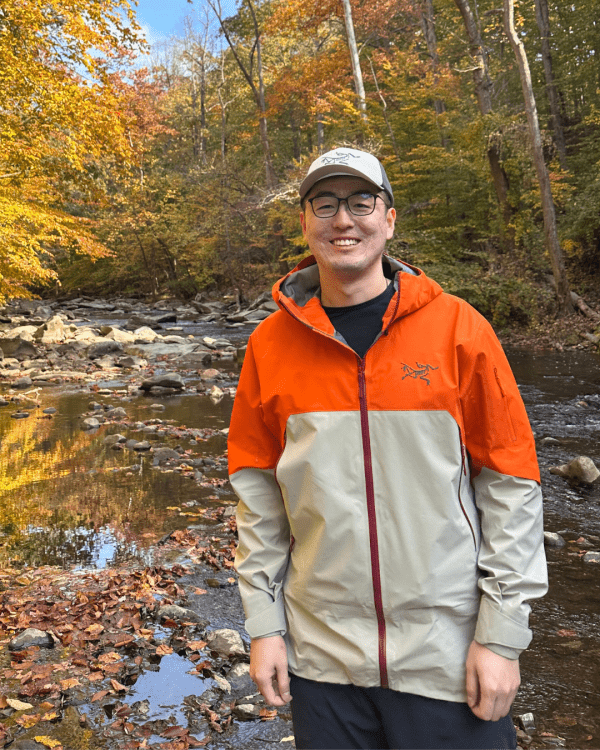
A smiling man stands in front of a shallow, rocky creek surrounded by a forest with vibrant yellow and orange autumn foliage. He is wearing a grey baseball cap, glasses, and a two-tone Arc'teryx outdoor jacket that is bright orange on the top half and light grey on the bottom. The ground is covered in fallen autumn leaves, and the trees are reflected in the calm water.

Blending ecosystems and machine learning, Wang is helping reshape how scientists forecast climate futures.

Ph.D. student Zhihao Wang, a graduate research assistant in the Department of Geographical Sciences, has been selected for the Graduate School’s Outstanding Graduate Assistant Award for AY 2025–26, placing him among the top 2% of more than 4,000 graduate assistants on campus. The award recognizes exceptional contributions graduate assistants make to students, faculty, departments, and the University as a whole. As part of the honor, Wang will receive a credit for mandatory Spring 2026 fees.

During his time as a graduate assistant, Wang focused on applying AI to large-scale ecosystem monitoring and long-term carbon forecasting. He led the creation of CarbonGlobe, a global multi-decade dataset and benchmark that enables AI to emulate long-term carbon dynamics, and TreeFinder, a U.S.-scale benchmark for mapping individual tree mortality using high-resolution aerial imagery. Both projects were accepted at NeurIPS 2025, a leading AI conference.

“One defining moment was when we demonstrated that our AI emulator, DeepED, could reproduce 40 years of global ecosystem simulations in just hours instead of months of high-performance computing, enabling scientists to explore far more future climate scenarios than previously possible,” Wang said. “it became clear that the work was not just a technical advancement, but a new way to approach large-scale, long-term ecosystem forecasting and tipping dynamics under diverse climate forcings.”

His advisor, Assistant Professor Yiqun Xie, highlighted Wang's impact: “Zhihao developed two large-scale, AI-ready datasets and new model benchmarks to push new frontiers in the AI-driven ecosystem modeling, with the papers published in NeurIPS 2025, a top venue of machine learning," he said. "Zhihao’s dedication consistently impresses me; it not only fuels his own research accomplishments but also motivates and inspires his peer.”

Wang’s work combines machine learning with ecological science. “What sets my work apart is a physics-guided AI approach to ecosystem forecasting. Rather than directly applying AI foundation models developed for generic computer science tasks, I design new architectures tailored to the unique challenges of global, long-term ecosystem modeling," he explained. "By integrating prior knowledge from the process-based ED (Ecosystem Demography) model, I ensure that AI predictions remain physically consistent and scientifically meaningful. This integration of machine learning innovation with established ecological knowledge allows the work to advance both computational efficiency and scientific consistency."

For Wang, the Graduate Assistant Award reflects recognition from a community that has supported his growth. "I am especially grateful to my advisor Dr. Yiqun Xie, and to the project PIs, Dr. George Hurtt and Dr. Lei Ma, for their guidance and support in pursuing ambitious research questions," he said.

He offers this advice for future graduate assistants: “Be fearless in pursuing interdisciplinary questions. The most meaningful advances often happen at the boundaries of fields, where curiosity, persistence and collaboration matter most.”

Image courtesy of Zhihao Wang

Published on Tue, 03/03/2026 - 14:29

College of Behavioral & Social Sciences
  • Facebook
  • Twitter
  • Instagram
  • YouTube
  • LinkedIn
  • Zenfolio

Department of Geographical Sciences

2181 Samuel J. LeFrak Hall, 7251 Preinkert Drive,
University of Maryland, College Park, MD 20742
Phone: 301-405-4050

Subscribe to Our Newsletter

Contact Us

Links
  • UMD Land Acknowledgement
  • UMD Staff Directory
  • Give to GEOG
  • UMD Web Accessibility
  • Alumni
© 2026 College of Behavioral & Social Sciences. All Rights Reserved.
Login