

Wild Ambitions for AI
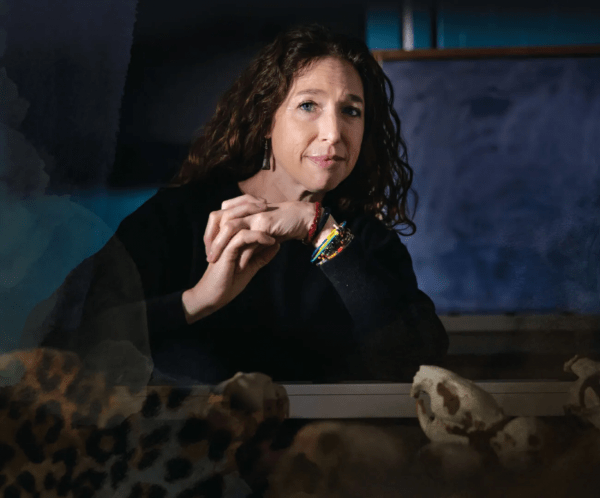
An illegal trade in animals is booming worldwide. Now, a UMD conservation criminologist is turning to artificial intelligence to snare smugglers and expose their networks.
MEREDITH GORE was eight-and-a-half months pregnant when a federal agent called with an unexpected request: Could she take in 900 other babies—the kind with shells? Customs agents at the Canada-Michigan border had just caught a man with “irregularly shaped bulges” in his sweatpants trying to smuggle what would amount to a small fortune in young terrapins to sell as illegal pets. Most were stuffed in cereal boxes in his luggage, but some were taped to his legs and groin.
“Just no. I’m a social scientist. I’m a dog person. I wouldn’t know what to do with 900 turtles,” Gore told the U.S. Fish and Wildlife Service agent.
But she had cared for confiscated reptiles at the authorities’ request before, so the then-Michigan State professor and expert on the illegal wildlife trade finally agreed to foster a solitary African spur tortoise that would serve as evidence to finally convict the smuggler.
The incident represented just one thread pulled out of the vast fabric of the global illegal wildlife trade, with an estimated annual U.S. value exceeding $1 billion; the worldwide total is anyone’s guess, Gore says. For every obvious criminal like the man with turtles in his pants, perhaps 100 more-creative ones slip through—hummingbirds nestled inside wigs, scorpions labeled as chocolates, seahorses buried in boxes of chili peppers, even iguanas stuffed into a prosthetic leg.
“We do a terrible job reducing the scope and scale of the illegal trade with seizures,” says Gore, today a human-focused geographer at the University of Maryland. One hurdle is the ceaseless demand for animals in traditional medicines and dishes in various cultures and their diaspora communities. Others are inconsistent data collection and reporting, and the herculean nature of organizing international law enforcement operations.
The environmental and social costs of this illicit trafficking are extreme: habitat destruction, loss of species, damage to human communities reliant on healthy ecosystems, even the potential spread of diseases and pandemics. “This is a massive driver of accelerating biodiversity loss on our planet—one that’s basically hidden,” Gore says.
But the environmental law enforcement challenges that seemed nearly insurmountable before look less so today, as artificial intelligence (AI) continues to grow in sophistication. The advanced computing methods can sift through vast piles of information, quickly find subtle connections that human researchers might be slow to spot—or never see—and suggest new approaches to solving some of the world’s greatest challenges.
Gore is collaborating with computer science experts at the University of Southern California (USC) to use machine learning and AI to leverage the “big data” available from airport crime and travel records. While the information can be gap-toothed, the team sees potential and has begun to demonstrate how the system could identify hotspots or smuggling routes, giving traffickers a run for their illegally gotten money in a kind of futuristic “CSI: Wildlife.”
This article was written by Jennifer S. Holland and originally published in Terp Magazine, Winter 2026.
Image: Portrait by John T. Consoli
Published on Fri, 01/23/2026 - 10:18