

While Global Forest Loss Rates Drop, Fire Threats Rise
Report by UMD, World Resources Institute shows that policies and action are slowing forest loss, but rising fire rates are acute
New data released by UMD’s Global Land Analysis and Discovery (GLAD) Lab and the World Resources Institute (WRI) shows that tropical rainforest loss fell worldwide by 36% in 2025. The findings suggest that strong environmental policies and enforcement can move the needle on forest loss.
Tropical primary forests are vital for climate stability and biodiversity, and offer sources of food, income and protection for millions of people worldwide. Their loss releases significant amounts of carbon. The research team said that loss of tropical primary forests weakens one of our planet’s most vital natural defenses against the impacts of climate change.
While the 2025 figures are an improvement over 2024’s record-high loss, experts caution that forest loss rates are still sobering, and that climate-driven fires have reached a dangerous new level, which could threaten any progress made in forest loss.
The findings from the Global Forest Watch report show that, in 2025, the world lost 10.6 million acres of tropical primary rainforest, an area roughly the size of Denmark. This rate is equal to 11 soccer fields of forest loss occurring every minute.
While these figures are sobering, the research team is encouraged by the slowed rate of forest loss compared to the 2024 data. The scientists attribute the improvement to environmental policies in key countries—including Brazil, Indonesia, Malaysia and Colombia—but assert that natural factors also come into play.
“A drop of this scale in a single year is encouraging—it shows what decisive government action can achieve,” said Elizabeth Goldman, co-director of WRI’s Global Forest Watch. “But part of the decline reflects a lull after an extreme fire year. Fires and climate change are feeding off each other, and with El Niño on the horizon for 2026, investments in prevention and response will be critical as extreme fire conditions become the norm.”
The research team also cautions that, in spite of this downward trend in forest loss, global forest loss is still far above the level required to meet multi-country goals. More than 140 countries came together under the Glasgow Leaders’ Declaration established in 2021 to commit to halting and reversing forest loss by 2030. Right now, current levels are about 70% too high to be on track to meet that goal.
Findings Reveal Alarming Global Increase in Fires
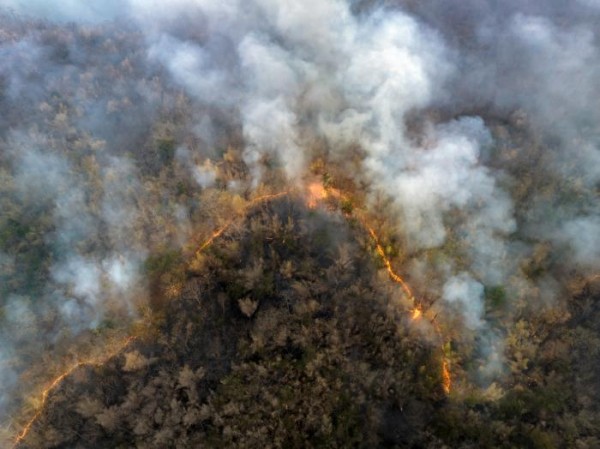
Human activity, primarily for agricultural use, is the leading cause of tree cover loss. However, fires continue to be an alarming driver of loss in 2025. Fires are responsible for 42% of tree cover loss globally. At 63.1 million acres, this amount of loss is greater than the size of the United Kingdom.
 Professor Matthew Hansen
The hotter, drier conditions experienced globally due to climate change allow fires to spread more easily. These release vast amounts of stored carbon, accelerating climate change in a dangerous, destructive cycle.
“Climate change and land clearing have shortened the fuse on global forest fires,” said Matthew Hansen, professor of geographical sciences and GLAD lab director. “Droughts are more severe, longer, and frequent. The result is higher fire risk for more and more forests. Policies to reduce this risk are a global-scale need.”
Ultimately, the GLAD Lab and WRI hope the data they gather and disseminate will inform policies and decisions that help countries around the world meet the 2030 goals set forth in the Glasgow Leaders’ Declaration.
“We are in a 'noisy' and unstable environment. While this past year featured lower overall forest loss, we have begun 2026 with record heat in much of the northern hemisphere,” Hansen said. “The goal of consistently low, and even decreasing, forest loss over the long-term may prove elusive.”
Image via iStock
This article was written by Laura Ours and originally published by the College of Behavioral and Social Sciences (BSOS).
Published on Thu, 04/30/2026 - 10:46