
UMD College of Behavorial & Social Sciences UMD College of Behavorial & Social Sciences
MENU

Topbar Menu

  • About Us
  • People
  • Alumni and Giving
  • Undergraduate
    • Prospective Students
    • Courses & Facilities
    • Advising
    • Special Programs
    • Graduation
    • Geography Club
  • Graduate
    • Prospective Ph.D. Students
    • Graduate Courses
    • Graduate Student Publications
    • Graduate Student Awards
    • Graduate Students
    • Combined BS/MS Program
    • Master of Science and Graduate Certificate Programs
    • MPS in GeoAI and Healthcare
  • Research
    • Research Areas
      • Geospatial-Information Science and Remote Sensing
      • Human Dimensions of Global Change
      • Land Cover and Land Use Change
      • Carbon, Vegetation Dynamics and Landscape-Scale Processes
    • Centers
      • Center for Geospatial Information Science
      • International Center for Innovation in Geospatial Analytics & Earth Observation
  • High School Hub
    • Program Overview
    • High School Awards
    • High School Internship Program
    • GIS Day
    • Request a Geographer
  • Resources
    • Graduate Student Organization
    • Student Life
    • Graduate School
    • Responsible Conduct of Research
    • Emergency Preparedness
    • Job Opportunities
    • Graduation
Search

Main navigation

  • Undergraduate
    • Prospective Students
    • Courses & Facilities
    • Advising
    • Special Programs
    • Graduation
    • Geography Club
  • Graduate
    • Prospective Ph.D. Students
    • Graduate Courses
    • Graduate Student Publications
    • Graduate Student Awards
    • Graduate Students
    • Combined BS/MS Program
    • Master of Science and Graduate Certificate Programs
    • MPS in GeoAI and Healthcare
  • Research
    • Research Areas
      • Geospatial-Information Science and Remote Sensing
      • Human Dimensions of Global Change
      • Land Cover and Land Use Change
      • Carbon, Vegetation Dynamics and Landscape-Scale Processes
    • Centers
      • Center for Geospatial Information Science
      • International Center for Innovation in Geospatial Analytics & Earth Observation
  • High School Hub
    • Program Overview
    • High School Awards
    • High School Internship Program
    • GIS Day
    • Request a Geographer
  • Resources
    • Graduate Student Organization
    • Student Life
    • Graduate School
    • Responsible Conduct of Research
    • Emergency Preparedness
    • Job Opportunities
    • Graduation
  • About Us
  • People
  • Alumni and History

Search our site:

UMD Wildfire Science Lab to Advance Satellite-Based Fire Monitoring
Breadcrumb

  • Home
  • Featured Content
  • UMD Wildfire Science Lab To Advance Satellite-Based Fire Monitoring
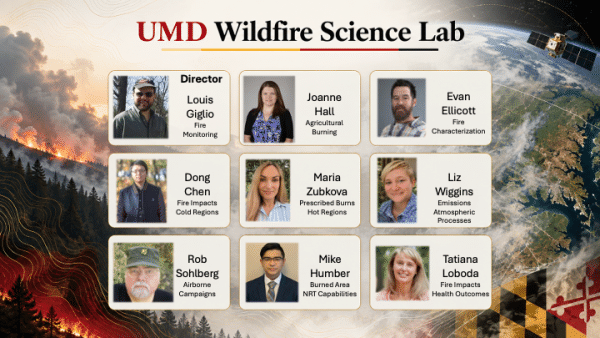
Promotional slide titled "UMD Wildfire Science Lab" with a red, yellow, and black underline. The background blends an image of a burning forest on the left with a satellite orbiting Earth over the Chesapeake Bay and a faded Maryland flag pattern on the right. In the center is a 3-by-3 grid of cards featuring headshots, names, and research specialties:   Row 1: Director Louis Giglio (Fire Monitoring); Joanne Hall (Agricultural Burning); Evan Ellicott (Fire Characterization).   Row 2: Dong Chen (Fire Impacts,

The new initiative builds on GEOG's long-standing contributions to satellite-based fire detection and monitoring.

The Department of Geographical Sciences (GEOG) recently launched the UMD Wildfire Science Lab, bringing together scientists from across the university and NASA's Goddard Space Flight Center to advance collaboration in wildfire monitoring, satellite observations and fire science.

Louis Giglio, a research professor at GEOG, is the lab's inaugural director. Giglio has played a leading role in developing satellite-based fire monitoring capabilities, including active fire detection algorithms that have supported operational fire monitoring for more than 26 years. His work has helped establish the satellite-based fire datasets that scientists and operational agencies rely on to monitor fires and study their effects on ecosystems and the atmosphere.

“At heart, we are looking to increase opportunities for collaboration, obviously within our own department, but also with respect to external partnerships and funding opportunities,” Giglio said. “Given the increasingly limited scale of the typical research grant, there is a tendency to become more siloed in our research. Establishing this more formal group will help to avoid that path and ultimately lead to better research.”

The lab's core members cover a wide range of wildfire research. Their work includes fire impacts and health outcomes (Professor and Chair Tatiana Loboda), agricultural burning (Associate Research Professor Joanne Hall), fire characterization (Associate Research Professor Evan Ellicott) and the effects of fire in cold regions (Associate Research Professor Dong Chen). Other research areas include prescribed burns in hot regions (Associate Research Professor Maria Zubkova), emissions and atmospheric processes (Associate Research Professor Liz Wiggins), burned-area mapping and near-real-time capabilities (Associate Research Professor Mike Humber) and airborne campaigns (principal faculty specialist Rob Sohlberg). The lab also draws on affiliated researchers from across UMD and its research partnerships.

“By bringing together researchers with different areas of expertise, skills and perspectives, we can tackle more complex fire-focused research questions and pursue opportunities that might be difficult for individual researchers to take on alone,” Giglio said.

The partnership with NASA Goddard will bring together complementary strengths in scientific research, satellite missions and operational fire monitoring.

“UMD brings considerable scientific expertise in algorithm development and validation and a strong research community, while Goddard brings NASA mission knowledge, satellite data capabilities, operational infrastructure and connections across NASA programs and the broader federal government,” Giglio said. “There are some new and exciting fire-related missions, for example, now coming out of Goddard on which we can make major contributions.”

The group plans to hold monthly meetings, including joint sessions with NASA Goddard's fire science teams. Participation will be by invitation, with meetings providing a forum for researchers to exchange ideas, discuss projects and identify opportunities for collaboration.

Through these partnerships, the UMD Wildfire Science Lab aims to strengthen the university's contributions to satellite-based fire observations and support the development of future wildfire monitoring capabilities.

Image courtesy of the UMD Wildfire Science Lab

Published on Fri, 11/13/2026 - 10:30

College of Behavioral & Social Sciences
  • Facebook
  • Twitter
  • Instagram
  • YouTube
  • LinkedIn
  • Zenfolio

Department of Geographical Sciences

2181 Samuel J. LeFrak Hall, 7251 Preinkert Drive,
University of Maryland, College Park, MD 20742
Phone: 301-405-4050

Subscribe to Our Newsletter

Contact Us

Links
  • UMD Land Acknowledgement
  • UMD Staff Directory
  • Give to GEOG
  • UMD Web Accessibility
  • Alumni
© 2026 College of Behavioral & Social Sciences. All Rights Reserved.
Login