

Rising Seas Could ‘Drown’ Mangroves, Release Carbon
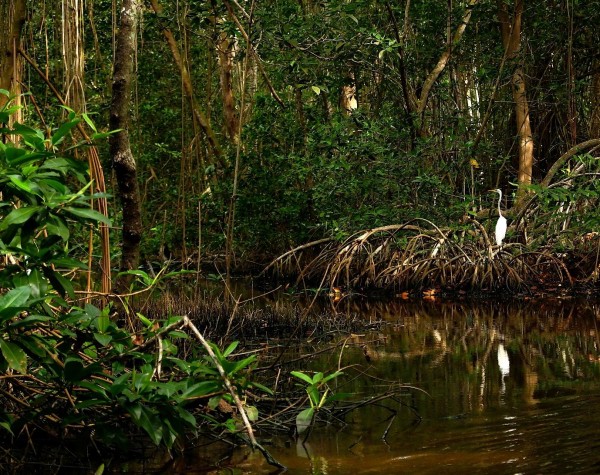
Assistant Professor Danghan Xie co-authored a study showing that mangroves could store less carbon—and even begin releasing it—as sea levels rise.
A new study finds that sea-level rise may boost carbon storage in some mangroves areas, but the broader pattern can be the opposite: entire forests may lose carbon as habitat shrinks and carbon-rich soils erode.
Mangroves cover less than 1% of Earth’s surface but store about 15% of global ocean carbon storage, largely in their soils. This belowground carbon can persist for decades to centuries, making mangroves long-term carbon “vaults.”
Because mangroves live in the tidal zone where land meets the sea, rising seas can push them beyond their limits, leading to dieback and soil erosion that can reduce, or even reverse, these climate benefits. A long-standing question has been whether mangrove landscapes will continue storing carbon as seas rise or lose carbon overall.
An international team including Danghan Xie, assistant professor in the Department of Geographical Sciences, developed a new numerical model to assess how sea-level rise will affect carbon storage across entire mangrove forests.
The findings show that while carbon storage may increase in localized areas as sea levels rise, it is likely to decline at the scale of whole forests over the next 100 years.
“Mangrove forests are efficient carbon sinks and are therefore crucial for slowing climate change,” said Arya Iwantoro, lead author of the study, who carried the research from the University of Exeter and is now based at the University of Plymouth.
Iwantoro noted that past research based on field observations has often suggested carbon storage may increase with sea-level rise, but those studies may not capture what happens across entire landscapes.
Xie helped build the modeling framework. “What’s new here is that the model does not just track sediment building the surface, as earlier models did,” he said. “It also includes belowground soil-building processes from roots and organic matter, alongside carbon."
In the simulations, many existing mangrove areas continued accumulating carbon under sea-level rise, but the net outcome across the whole landscape could still be negative as suitable habitat shrinks and carbon-rich soils erode.
Some forests may also remain standing while carbon accumulation slows, levels off, or even declines as sea-level rise reshapes local flooding and sediment delivery patterns, underscoring that mangrove survival does not always translate into continued carbon gains.
“As well as being vital carbon stores, mangroves protect coasts from storms, provide livelihoods to coastal communities and habitats for a wide range of species,” said Barend van Maanen, a co-author of the study. ”Our findings emphasize that understanding the coastal landscape as a whole is crucial when predicting how mangroves might respond to climate change and how we can protect them.”
Mangroves also play an important role in the United States, especially in Florida and along the Gulf Coast, where they support coastal protection and growing interest in blue carbon—carbon stored in oceans and coastal ecosystems.
“For the U.S., this matters for how we interpret monitoring data and how we plan restoration or conservation,” Xie added. “If we only track a few sites, we may miss whether the broader mangrove landscape is actually gaining carbon, or quietly losing it. Even when carbon builds up at a site early on, that does not guarantee the same site will keep gaining carbon in the future.”
The study was funded by the Natural Environment Research Council.
Paper: Iwantoro, A. P., Urrego, D. H., Xie, D., Nicholas, A. P., Hapsari, K. A., Rodríguez-Rodríguez, J. A., Restrepo, J. C., Polanía, J., Aalto, R. E., Gómez Vargas, L. F., & van Maanen, B. (2026). The importance of scale in the future of mangrove blue carbon under sea-level rise. Earth's Future, 14, e2025EF006984. https://doi.org/10.1029/2025EF006984
Photo by Luisa Gómez Vargas: Cispata Bay, Colombia
Published on Wed, 06/03/2026 - 12:47