
UMD College of Behavorial & Social Sciences UMD College of Behavorial & Social Sciences
MENU

Topbar Menu

  • About Us
  • People
  • Alumni and Giving
  • Undergraduate
    • Prospective Students
    • Courses & Facilities
    • Advising
    • Special Programs
    • Graduation
    • Geography Club
  • Graduate
    • Prospective Ph.D. Students
    • Graduate Courses
    • Graduate Student Publications
    • Graduate Student Awards
    • Graduate Students
    • Master of Science and Graduate Certificate Programs
    • Combined BS/MS Program
  • Research
    • Research Areas
      • Geospatial-Information Science and Remote Sensing
      • Human Dimensions of Global Change
      • Land Cover and Land Use Change
      • Carbon, Vegetation Dynamics and Landscape-Scale Processes
    • Centers
      • Center for Geospatial Information Science
      • International Center for Innovation in Geospatial Analytics & Earth Observation
  • High School Hub
    • Program Overview
    • High School Awards
    • High School Internship Program
    • GIS Day
    • Request a Geographer
  • Resources
    • Graduate Student Organization
    • Student Life
    • Graduate School
    • Responsible Conduct of Research
    • Emergency Preparedness
    • Job Opportunities
    • Graduation
Search

Main navigation

  • Undergraduate
    • Prospective Students
    • Courses & Facilities
    • Advising
    • Special Programs
    • Graduation
    • Geography Club
  • Graduate
    • Prospective Ph.D. Students
    • Graduate Courses
    • Graduate Student Publications
    • Graduate Student Awards
    • Graduate Students
    • Master of Science and Graduate Certificate Programs
    • Combined BS/MS Program
  • Research
    • Research Areas
      • Geospatial-Information Science and Remote Sensing
      • Human Dimensions of Global Change
      • Land Cover and Land Use Change
      • Carbon, Vegetation Dynamics and Landscape-Scale Processes
    • Centers
      • Center for Geospatial Information Science
      • International Center for Innovation in Geospatial Analytics & Earth Observation
  • High School Hub
    • Program Overview
    • High School Awards
    • High School Internship Program
    • GIS Day
    • Request a Geographer
  • Resources
    • Graduate Student Organization
    • Student Life
    • Graduate School
    • Responsible Conduct of Research
    • Emergency Preparedness
    • Job Opportunities
    • Graduation
  • About Us
  • People
  • Alumni and History
  • Diversity

Search our site:

Ph.D. Student Student Receives American Geographical Society Fellowship
Breadcrumb

  • Home
  • Featured Content
  • Ph.D. Student Student Receives American Geographical Society Fellowship
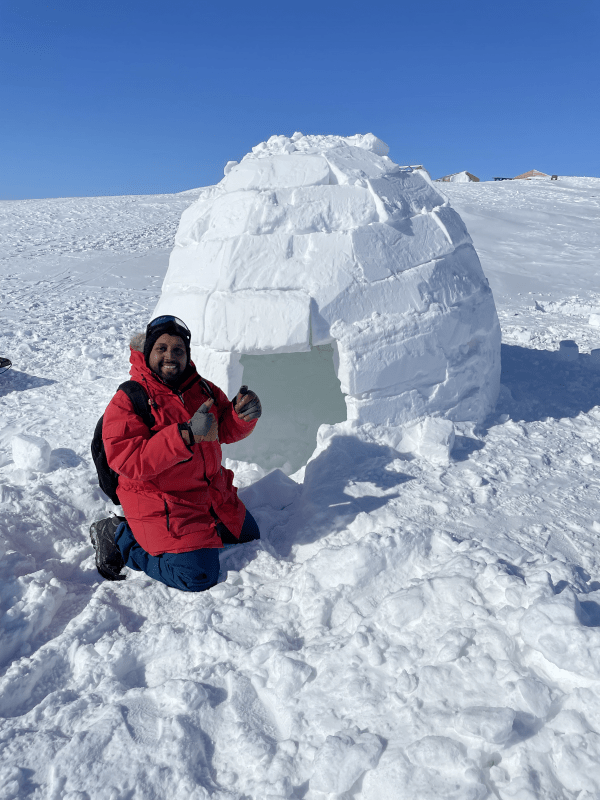
A man in a bright red parka, blue snow pants, and a backpack kneels in the snow next to a large, hand-built igloo made of stacked snow blocks. He is smiling and giving a thumbs-up. The scene is set on a vast, sunlit snowfield under a clear blue sky, with a few distant structures visible on the horizon.

Award supports Monojit Saha's research, which focuses on improving satellite observations of Arctic coastal sea ice.

Ph.D. student Monojit Saha in the Department of Geographical Sciences has received a fellowship from the American Geographical Society.

The AGS Council Fellowship provides $2,000 to support graduate student scholarship and is open to master’s and doctoral students across the United States pursuing research in any subfield of geography. The program is designed to advance geographical knowledge, with an emphasis on innovative research and, in many cases, fieldwork.

“Receiving this fellowship is incredibly meaningful to me,” he said. “It not only supports my research financially, but also strengthens my confidence in the value and direction of my work. As a geographer working at the intersection of geography and polar science, it is especially rewarding to be recognized by the American Geographical Society.”

His research focuses on improving satellite-based measurements of sea ice in near-coastal Arctic regions, where existing data can be unreliable. By developing new algorithmic approaches, he aims to address the challenges of these complex environments and produce more accurate, actionable information.

“These areas are critically important for communities that depend on sea ice for travel and subsistence,” he said. “What distinguishes this work is its integration of satellite data and methodological innovation.”

The fellowship will also provide opportunities to share his work more broadly and engage with researchers across the field, including complementary registration for the AGS Fall Geography 2050 Symposium on Nov. 19 and 20 in New York.

“I’m particularly excited to share my thesis research on improving near-coastal Arctic observations using satellite remote sensing with the broader geography community,” he said. “I also look forward to connecting with researchers across diverse subfields and exploring advanced approaches such as Geo-AI that I hope to integrate into polar studies.”

The AGS Council Fellowship program encourages recipients to contribute to the discipline through publication and collaboration, helping bring emerging research to a wider audience.

Photo of field work at Cambridge Bay, Nunavut, courtesy of Monojit Saha

Published on Wed, 04/01/2026 - 10:04

College of Behavioral & Social Sciences
  • Facebook
  • Twitter
  • Instagram
  • YouTube
  • LinkedIn
  • Zenfolio

Department of Geographical Sciences

2181 Samuel J. LeFrak Hall, 7251 Preinkert Drive,
University of Maryland, College Park, MD 20742
Phone: 301-405-4050

Subscribe to Our Newsletter

Contact Us

Links
  • UMD Land Acknowledgement
  • UMD Staff Directory
  • Give to GEOG
  • UMD Web Accessibility
  • Alumni
© 2026 College of Behavioral & Social Sciences. All Rights Reserved.
Login