

The Path of a Professor Laixiang Sun: A Global Scholar Grounded in Rural China

From a humble upbringing to the forefront of global research at the University of Maryland, Sun pushes traditional boundaries in human geography, integrating social and natural sciences to tackle some of today’s most pressing issues.
In Qin'an County, China, where people lived the same way for thousands of years, grinding their own flour and making their own clothes, a young scholar imagined a life yet to come where having enough food was the norm rather than a luxury. "When I was a child, my dream was to say in the future I will have enough food," Professor Laixiang Sun recalled, narrowly surviving a devastating famine as a small child in the early sixties.
Life in his village was marked by scarce resources and relentless labor during the Cultural Revolution, from 1966 to 1976, when political campaigns upended society and left many struggling to meet basic needs. Sun’s father moved to another city to earn a living in the textile industry, returning home only when he could, while his grandfather guided the family through uncertain times, instilling lessons in perseverance and self-reliance. Second of four siblings, Sun spent his days tending the farm, observing the quiet resilience of neighbors and absorbing his grandfather’s repeated message: education was the only path to a different future. Those lessons stayed with Sun, shaping his determination to pursue knowledge despite the hardships surrounding him.
 Typical farmland in Qin’an County, China.
Despite these challenges, Sun pursued education with relentless focus. Inspired by books such as “Ten-Thousand Why’s” that his father brought home, he developed an early fascination with science and mathematics. During a time when schools were disrupted by the Cultural Revolution, he relied heavily on self-study, mastering subjects largely on his own. When universities reopened, he faced a fiercely competitive entrance exam—only 400,000 of more than 6 million candidates were admitted—but his discipline and preparation paid off.
Sun eventually earned a place at Peking University to study mathematics, joining a class that would sharpen both his analytical skills and his global perspective. “So all the classmates, the teachers, feel I’m one of them,” he said, reflecting on the acceptance he found there. During his postgraduate study, he met his future wife, a fellow student in English class, whose companionship helped him feel a sense of belonging in academic circles even before he ventured abroad.
A Global Scholar Emerges
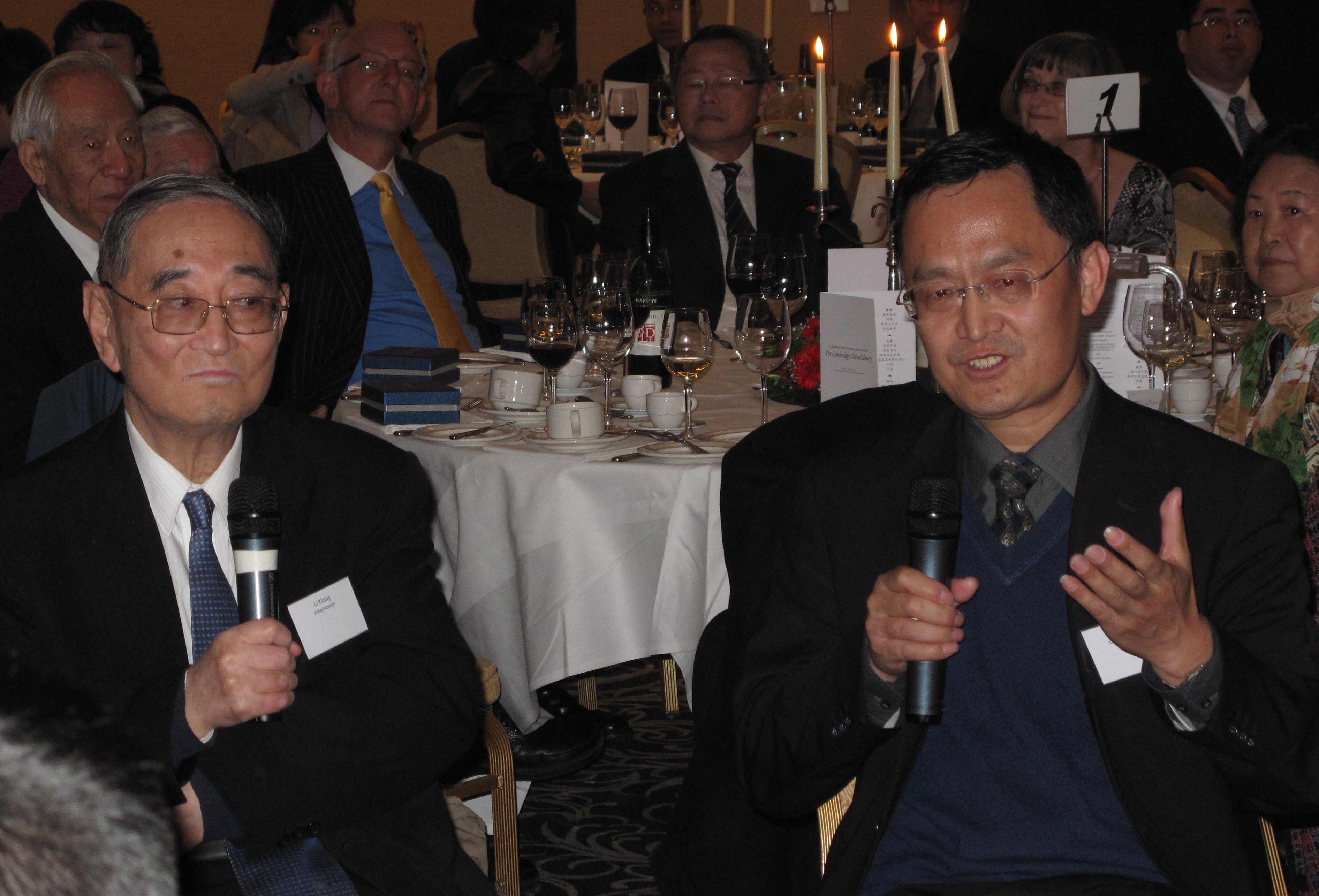
From left to right: Renowned economist and distinguished Peking University professor Li Yining with Professor Laixiang Sun in London, Jan. 21, 2012.
After studying and teaching in Peking University for more than 10 years, Sun received a scholarship to study economics in Europe, a rare opportunity as countries began opening doors to China’s emerging scholars. At the International Institute of Social Studies of Erasmus University Rotterdam in The Hague, he studied alongside classmates from India, Vietnam, Brazil, Argentina, Bolivia and countries across Africa. “We had all kinds of in- and after-class discussions. We marched together. We chatted about different countries,” he recalled. This exposure to multiple cultures and systems honed his ability to compare institutional arrangements across nations.
The diversity of experiences also broadened his view of global development. “One of my classmates, after he got his PhD from this institute, returned to Bolivia. Three years later, he became the head of the Statistical Bureau in Bolivia,” Sun said, marveling at how quickly advanced education could shape careers and societies.
Upon graduating, Sun moved to the United Nations University, managing projects that assisted former Soviet and Eastern European countries in transitioning to market economies. He organized scholars from across the region, facilitating discussions grounded in evidence-driven research. “It’s all linked to economics, institutional and comparative economics,” he said. This work reinforced the importance of observing different systems and cultures, lessons he carried into later teaching and research.
The Power of Systems Analysis and Applied Research
Sun’s next career step brought him to a position at the International Institute for Applied Systems Analysis in Austria, where he discovered systems analysis—a method to connect social, economic and environmental factors in a single framework. “I make links,” he said. Using systems thinking and integrated modeling, he studied complex socio-economic and environmental systems, allowing him to examine interactions between human activity and nature and address uncertainty in large-scale systems. This approach became the backbone of his research.
His projects often focused on China’s agricultural development and potential trade implications of its accession to the World Trade Organization. Remote sensing data revealed that official Chinese statistics underestimated land resources by roughly one-third. “Otherwise, you really do not know how much land is really used for agriculture,” he noted. The findings from his projects informed policy discussions and demonstrated the power of combining geo-referenced data with economic modeling.
Since 1997, Sun had lived and worked in several countries, raising his son in Europe. In 2001, they moved to the United Kingdom, where he joined SOAS University of London and became professor and head of the Department of Financial and Management Studies. The school, with its roots in training civil servants and diplomats during the British Empire, offered a highly international environment. “British diplomats, especially in developing countries, many of them had training at SOAS,” he said. He also maintained an international research portfolio, continuing collaborations with China and other countries.
A Strategic Recruitment to Maryland
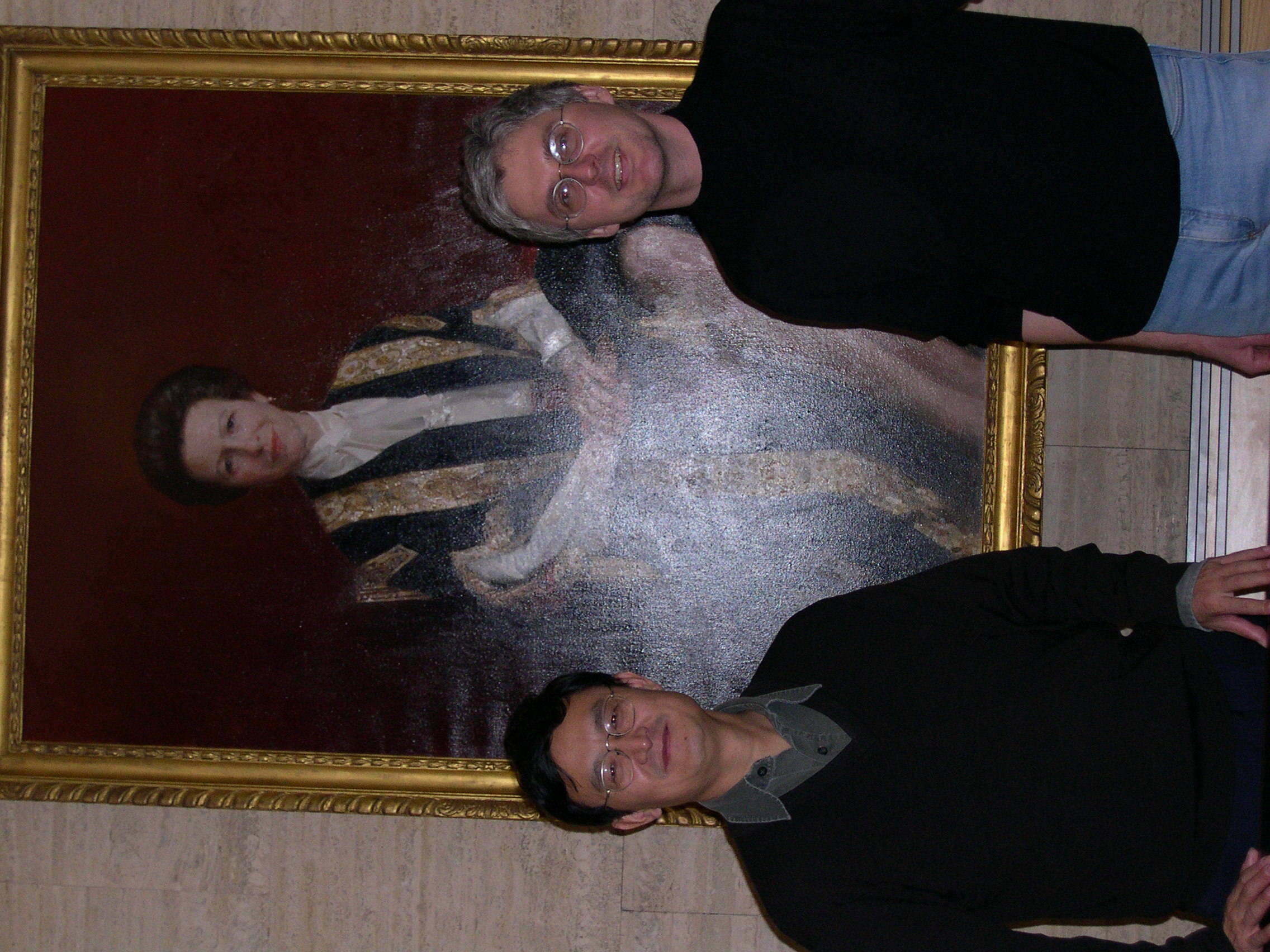 Sun and Adjunct Professor Klaus Hubacek at Senator House of the University of London, circa 2005.
Sun’s path to the University of Maryland grew naturally from longstanding collaborations and the department’s commitment to strengthening human geography. At the time, GEOG was focused on building a more integrated cohort of scholars in that field. When Emeritus Professor John Townshend became dean, he opted to recruit a cluster of scholars rather than hiring individually. He brought in Klaus Hubacek, one of Sun’s former students from his years at IIASA, along with several colleagues who shared academic ties to the United Kingdom. Hubacek, now an adjunct professor, and Distinguished University Professor Chris Justice (then GEOG chair) later visited Sun in London to discuss the department’s growth and how his work might fit into the expanding group. The opportunity aligned well with Sun’s own trajectory. As a department chair at SOAS, he was managing heavy administrative loads with limited staff support, and Maryland offered a strong research environment with direct connections to NASA that complemented his projects.
Sun and his wife decided to visit campus for a month to get a sense of life in the United States. Sun attended departmental retreats and meetings, while his wife explored the area on her own, renting a car and driving through the region. The visit gave them a clear picture of the community and quality of life. With their son already an independent adult working in banking in the United Kingdom, the decision to relocate became simpler. Sun joined Maryland in 2013 alongside several other international scholars, stepping into a department where collaborations with colleagues like Hubacek were already well established.
Research and Teaching at UMD
 Early summer's view of Sun's garden.
At UMD, Sun’s work extends human geography by combining systems modeling with geo-referenced data to study coupled human and natural systems. This integrated approach has led to high-profile publications in Nature, PNAS, and other Nature journals such as Nature Sustainability, Nature Food, Nature Water and Nature Cities. His projects tackle global challenges, including carbon-neutral steel production and planetary boundaries, with his latest Nature paper highlighting cost-effective strategies for reducing steel industry emissions.
Sun emphasizes connecting students to current social concerns and frontier scientific research. He strives to make cutting-edge studies accessible, using real-world examples like gerrymandering or comparative election systems. “Link teaching to the most current social concerns of society,” he said. “The very good scientific research must be accessible to university students.” His approach fosters critical thinking across disciplines.
Even outside academia, Sun maintains a disciplined and grounded life. Daily walks with his wife after meals complement this routine. Gardening is his primary hobby, a connection to his upbringing as the child of farmers. He tends more than 2,000 square meters of land, finding in the work a continuity with human history. “Our human race, for more than 10,000 years, just did farming. Based on evolutionary theory, we still are farmers,” said this global scholar, never forgetting his roots.
Main photo: Professor Laixiang Sun at a UN meeting on July 31, 2002. All photos courtesy of Sun
Published on Tue, 12/02/2025 - 16:00