

Often Overlooked, Trees Outside Forests Store a Significant Share of Maryland’s Carbon
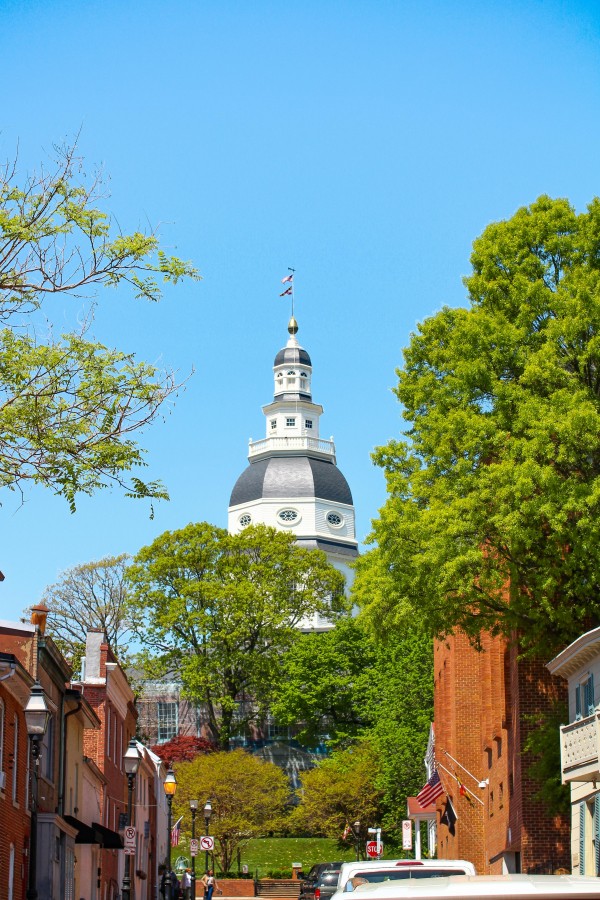
UMD researchers find that non-forest trees account for nearly one-quarter of the state’s annual tree-related carbon absorption.
A single tree may not look like much on its own. But across Maryland, millions of trees growing along roads, in neighborhoods and on agricultural land play a significant role in storing carbon and absorbing carbon dioxide from the atmosphere, according to new research.
The research shows that trees outside forests account for nearly a quarter of Maryland’s total tree-related carbon absorption each year and a sizable share of the state’s overall tree carbon storage. Yet these trees are often missing from traditional carbon tracking efforts.
Most land-based carbon monitoring systems were designed with forests in mind, said Ph.D. student Quan Shen, the paper’s lead author. Co-authors include members of UMD's Global Ecology Lab team and scientists from the State of Maryland.
“Traditional field inventories and satellite products work very well for forests, but not so good with trees that are small and scattered,” Shen said. “At coarse spatial resolutions, these trees are either mixed into non-forest land cover or missed entirely, so they fall through the cracks of carbon accounting.”
Recent advances in remote sensing made the study possible. The research team combined very high-resolution aerial imagery and LiDAR data — which use laser pulses to measure vegetation structure — with computer models that simulate how trees grow and die over time. This approach allowed the team to identify individual trees across the state and track changes from 2011 to 2023.
The results showed that trees outside forests made up about 23% of Maryland’s total tree cover and contributed more than 22% of the carbon dioxide absorbed by trees each year during the study period. They also accounted for nearly 15% of the carbon stored in live trees above ground, despite being smaller and more spread out than forest trees.
“The most striking result for me was how large the contribution of trees outside forests turned out to be,” Shen said. “That is a substantial share for something that is rarely highlighted in carbon budgets.”
The researchers found that about 90% of trees outside forests were located on developed and cultivated lands, including cities, suburbs and farmland, and these trees accounted for the vast majority of carbon uptake from non-forest trees.
The findings have implications for how communities think about climate change mitigation and land management.
“The results provide evidence that trees outside forests matter for climate mitigation, not just for aesthetics or local benefits,” Shen said. “This means that street trees, yard trees and small green spaces can collectively add up to a meaningful carbon benefit, especially when they are protected and allowed to mature. These findings support policies that go beyond forest conservation alone. Programs aimed at urban tree planting, protecting mature trees during development, or maintaining trees on private lands can now be linked more directly to carbon outcomes.”
The researchers also highlighted that trees outside forests can be more vulnerable than forest trees. “Those on private or municipal land can be removed quickly due to development or infrastructure changes. They also experience stronger edge effects and are often more exposed to wind, heat and other stresses than trees in closed-canopy forests,” Shen explained.
Between 2011 and 2023, persistent trees outside forests increased their carbon storage by more than 5 million metric tons, representing nearly a quarter of the total increase in Maryland’s tree carbon storage over that period. The amount of carbon absorbed each year varied widely, reflecting changes in weather, land use and tree management.
At the same time, some trees outside forests benefit from active care. “Many trees outside forests are actively managed (watered, mulched, pruned), which means they can sometimes recover faster or be replaced more easily than forest trees,” Shen said.
As technology continues to advance, Shen said that better data could help governments target investments more strategically, prioritizing areas where trees deliver strong carbon benefits along with co-benefits such as cooling and improved air quality.
Paper: “Trees outside forests and their carbon dynamics over Maryland, U.S.A.” Quan Shen, George C Hurtt, Lei Ma, Elliott Campbell, Janna Chapman, Reem A Hannun, Jennifer Kennedy, Rachel Lamb, Frances Marie S Panday, Joseph Sullivan. Environmental Research Letters, Volume 21, Number 2. https://iopscience.iop.org/article/10.1088/1748-9326/ae301d#erlae301df8
Photo by Priscilla Palm via Pexels: Annapolis Maryland State House and Historic Streetview
Published on Fri, 01/23/2026 - 16:16