

New Studies Reveal Where and Why Conservation Crime Happens
Research in Vietnam finds that conservation crime is driven by lived pressures and place-based dynamics that extend far beyond protected area boundaries.
When GEOG researchers spoke with people living near Pù Mát National Park, conversations often drifted away from the forest itself. People talked about roads, distance, land access and small decisions that shape daily life. Over time, a clearer picture emerged: what happens inside the park cannot be separated from what happens outside it.
That insight lies at the center of two new studies examining conservation crime and its prevention around one of Vietnam’s most important protected areas. Based on years of fieldwork and close collaboration with local communities, the research shows that illegal wildlife use is shaped by environments that make poaching possible and by social, economic and environmental pressures people face every day.
The studies are the latest outcomes of a decade-long collaboration led by Professor Meredith Gore and partners in Vietnam, including Re:Wild, Fauna & Flora, and Vinh University. The team has worked alongside park staff, rangers, police and local communities to advance understanding about conservation crime prevention on the ground in a country known as a transit and destination hub for trafficked wildlife.
“It is really rewarding to see new research that builds directly on conclusions and recommendations from prior research while at the same time building the capacity of UMD Ph.D. students to conduct fieldwork and original research,” Gore said.
The two new papers, led by Ph.D. students Judith Rakowski and Jingjing (Elle) Xu, examine conservation crime and its prevention from different but complementary angles. Rakowski explores strains shaping people’s decisions about forest use, while Xu focuses on the places that support poaching activity and how those spaces are organized.
The Pressures Behind Illegal Forest Use
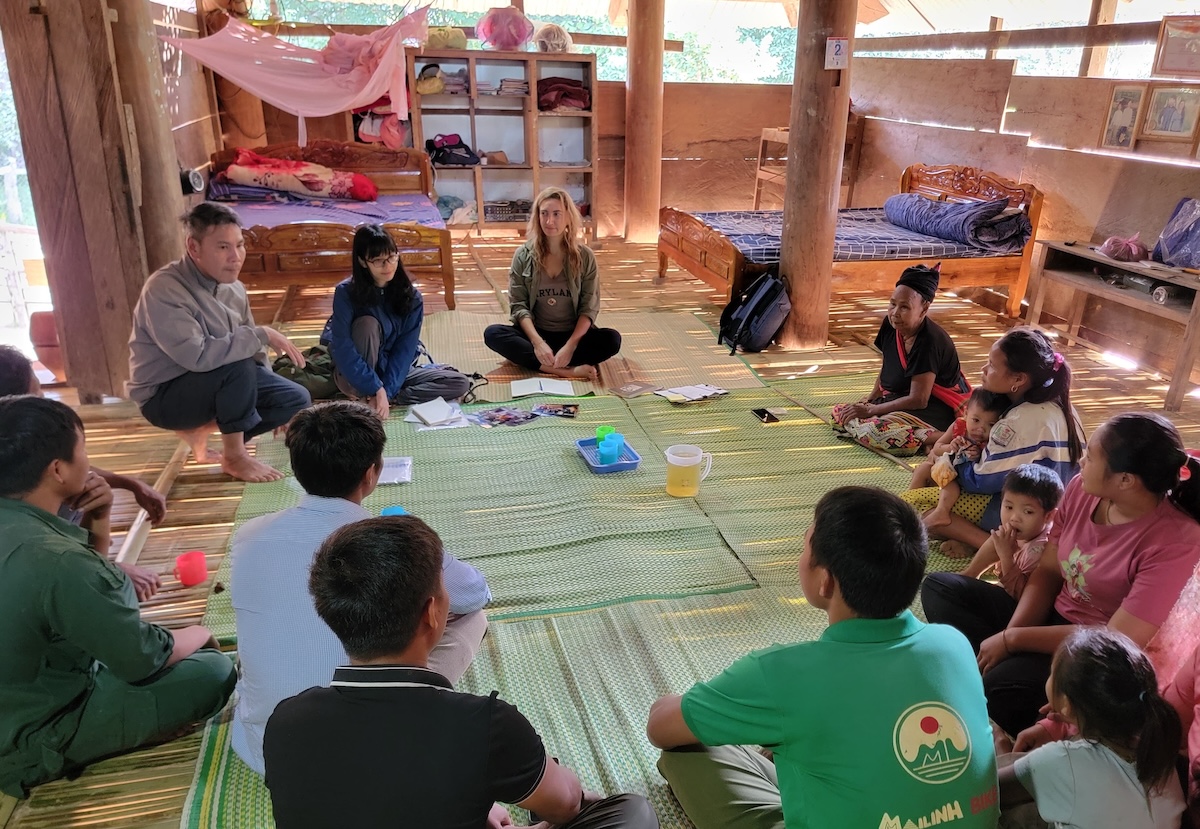
Judith Rakowski conducts a participant validation workshop to share preliminary findings and gather feedback from residents of Bung village, December 2024.
Rakowski’s paper addresses a straightforward but often overlooked question: what pressures do people living near protected areas face and how do those pressures shape their behaviors?
Drawing on interviews, focus groups and community workshops across 16 communities in the park, Rakowski applied General Strain Theory, a framework from criminology, in a novel conservation context. The theory suggests that strains, such as the loss of something positive or barriers to goals, may develop stress that increases the likelihood of coping through deviant or illegal behavior.
“I found that people described nine ‘strains,’ including four ecological place-based strains that have never been described—like remoteness/road conditions and environmental stressors,” Rakowski said. “A second key finding is that it’s not just the strain itself that can drive behavior—it’s whether people have realistic coping options for those strains.” She explained that when access to legal coping strategies is limited because of poverty, isolation, language or unequal access to services, strains can compound in severity, sharpen inequality and drive conservation crime.
One striking finding, Rakowski said, was that conservation crime emerged as the most frequently mentioned coping strategy. Unlike alternatives such as outmigration or livelihood change, conservation crime did not require additional resources. She also emphasized she learned a lot about the importance of qualitative research for conservation crime prevention in building understanding about on-the-ground complexities and for moving beyond narratives that oversimplify poverty as the primary driver for conservation crime.
Mapping the Places That Enable Poaching

Jingjing (Elle) Xu marks hunting-associated locations during a participatory mapping session at a local household in the buffer zone of Pù Mát National Park on Oct. 24, 2025.
While Rakowski’s work focuses on why conservation crime happens, Xu examines where it takes shape. Using participatory mapping and Place Network Investigations (PNI)—an approach that examines how various types of places are used as part of the crime process—she worked with both conservation experts and local residents to identify locations linked to poaching to help inform crime prevention strategies.
“The PNI approach considers non-crime locations that support illegal hunting activities, thereby revealing additional locations for crime prevention,” Xu said. “Place matters as it shapes the environment in which people live. Understanding place-networks help inform place management solutions and crime prevention priorities.”
Her findings suggest the need to broaden prevention efforts as poaching cannot be addressed solely through enforcement inside protected areas when poaching-facilitating activities occur outside park boundaries. Xu also found that local communities consistently had different understanding of where wildlife crime-related places were compared with experts.
“Local communities exhibited broad spatial knowledge of the hunting practices, which complemented the spatial knowledge sourced from experts and law enforcement records. Together, they provide a more complete understanding of where poaching-associated activities operate,” she said.
Xu was struck by the effect of taking the time to build trust and avoid stigmatizing language during fieldwork: “What surprised me most was how openly communities could share their hunting practices when they were approached with respect and treated as equals, as well as adequate trust-building.” The use of terms such as “illegal,” “poaching” or “crime” by conservationists often creates a taboo that discourages open discussion and can generate conflict between stakeholders, she explained. “Crime is socially constructed, and hunting has long been part of local communities’ culture and history.”
Rather than seeing hunters solely as offenders, Xu underscores their potential role in conservation crime prevention. “This all suggests that co-designed sustainable management is very much possible when communities are recognized as knowledge holders and problem solvers,” she said.
Rethinking Conservation Crime Prevention
Rakowski’s and Xu’s studies highlight that addressing conservation crime cannot be limited to law enforcement inside protected areas. Instead, effective interventions must consider both the social pressures people face and the places linked to those where illegal activities occur—lessons that could apply to other contexts worldwide.
The authors aspire for their research to guide more effective and equitable conservation crime prevention. “I hope it helps conservation practitioners and decision-makers design prevention that is more realistic, effective, and fair—by identifying which strains are most severe, and by investing in crime prevention strategies that both reduce harm and expand legal coping pathways,” Rakowski said.
They emphasize that collaboration is the key to lasting solutions. “I hope this work bridges multiple stakeholders together to co-design place-based solutions to address the conservation challenges in the park,” Xu added.
This research was supported by UK Aid via their Illegal Wildlife Trade Challenge Fund Program.
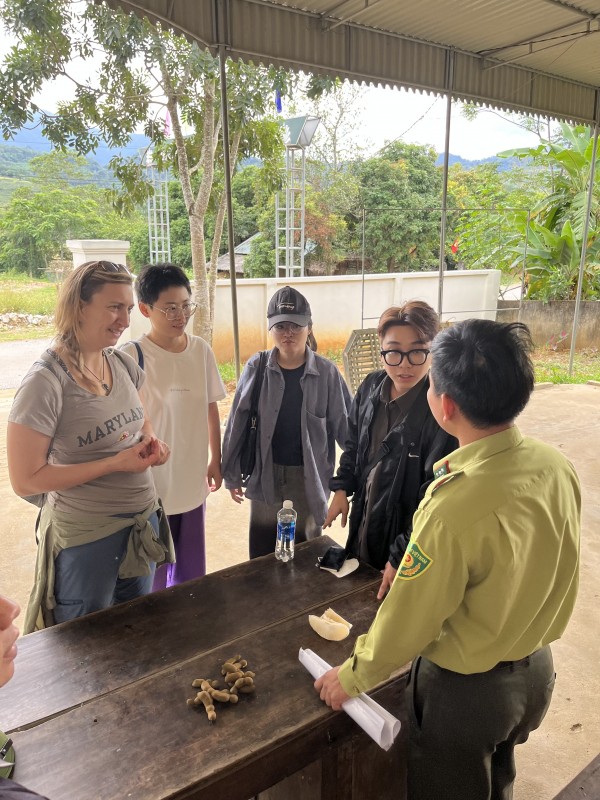
Photos courtesy of Meredith Gore, Judith Rakowski and Jingjing (Elle) Xu. Main image: UMD researchers and translators chat with rangers in a village in the Pù Mát National Park's buffer zone on Oct. 20, 2025.
Papers
Rakowski, J. J., Anagnostou, M., Cao Tien, T. D., Cao Tien, T., Joanny, L., Nguyen, H. T., Slade, J. L., Nguyen, L. V., Xu, E. J., & Gore, M. L. (2026). When coping means breaking the rules: Understanding conservation crime through strain. Biological Conservation, 315, 111687. https://doi.org/10.1016/j.biocon.2025.111687
Xu, E. J., Cao, D. T. T., Xu, X., Rakowski, J. J., Nguyen, L. V., Joanny, L., Slade, J. L., Herold, T. D., Cao, T. T., & Gore, M. L. (2025). Exploring neglected places enabling conservation crime through place network investigations.iScience, 114384. https://doi.org/10.1016/j.isci.2025.114384
Published on Thu, 01/15/2026 - 13:45