

New Database Improves Carbon Accounting for Tropical Forests
Postdoctoral researcher Amelia Holcomb co-led a 41-researcher collaboration that synthesized data from 146 tropical forest studies.
A new international study has created a comprehensive database documenting the effects of tropical forest disturbance and recovery on carbon storage, providing countries with stronger tools for climate reporting and forest conservation.
Published in Science Advances, the study synthesized data from 146 studies of tropical moist forests conducted since 1988 to quantify carbon losses and gains following forest degradation, deforestation and regeneration. The new database is expected to improve national greenhouse gas inventories and reporting to the United Nations Framework Convention on Climate Change (UNFCCC).
Tropical moist forests contain about 70% of the world's living biomass and play a critical role in absorbing carbon dioxide from the atmosphere. While scientists have long understood the impacts of deforestation, the effects of forest degradation—partial damage caused by selective logging, fires, drought, storms and forest fragmentation—are much harder to measure.
The researchers found that degradation can result in substantial carbon losses. On average, forest fires reduced aboveground carbon by 49%, selective logging by 34% and forest edge effects by 31%. More frequent and severe disturbances led to even greater losses.
The study also found that degraded forests recover carbon much more quickly than forests regenerating after complete clearing. After 20 years, recovering degraded forests stored 41% to 117% more aboveground carbon than secondary forests regrowing after deforestation.
"Forest degradation occurs on a spectrum, and a degraded forest is not a lost forest—every action we can take to reduce the intensity and frequency of disturbance helps maintain the structural integrity these ecosystems need to bounce back," said co-lead author Amelia Holcomb, postdoctoral researcher in the Department of Geographical Sciences.
The findings highlight the importance of protecting forest structure, soils and seed sources, which help forests recover more rapidly and continue storing carbon.
The research is the outcome of a workshop at the GFZ Helmholtz Centre for Geosciences in Potsdam, Germany, convened by co-lead author Viola Heinrich. The international consortium of 41 researchers from 34 institutions developed the database to provide standardized estimates of carbon losses and recovery that can improve carbon models and support more consistent climate reporting. Countries are already beginning to use the resource. Nigeria incorporated the data into its 2026 Forest Reference Emission Level submission, demonstrating its value for strengthening forest carbon accounting and supporting climate mitigation efforts.
Paper: Heinrich, V., Holcomb, A., Besnard, S., Requena Suarez, D., Cook-Patton, S., Bourgoin, C., Chazdon, R., Gibbs, D. A., Mendes, F. S., McNicol, I., Wheeler, C., Silva-Junior, C. H. L., Amani, B. H. K., Bastin, J.-F., Nguba, T. B., Chen, N., Chen, H., Ciais, P., Dalagnol, R., . . . Herold, M. (2026). A meta-analysis of carbon losses and gains from tropical moist forest degradation and regeneration. Science Advances, 12, eadz1923.
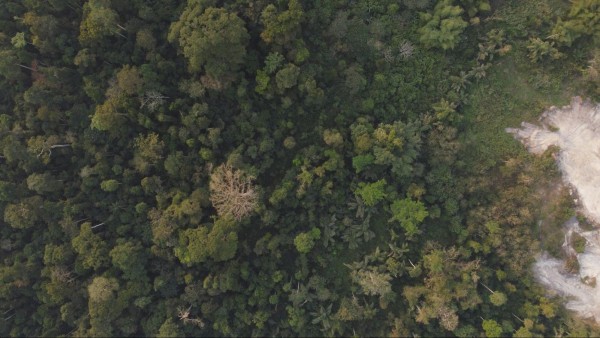
Image: Aerial imagery highlighting the diversity of tropical forest degradation and recovery processes happening in Ghana. Photo by Johannes Wilk at GFZ\
Published on Fri, 07/24/2026 - 09:22