

High School Interns Tackle Real-World Challenges Through AI, Remote Sensing and Geospatial Research
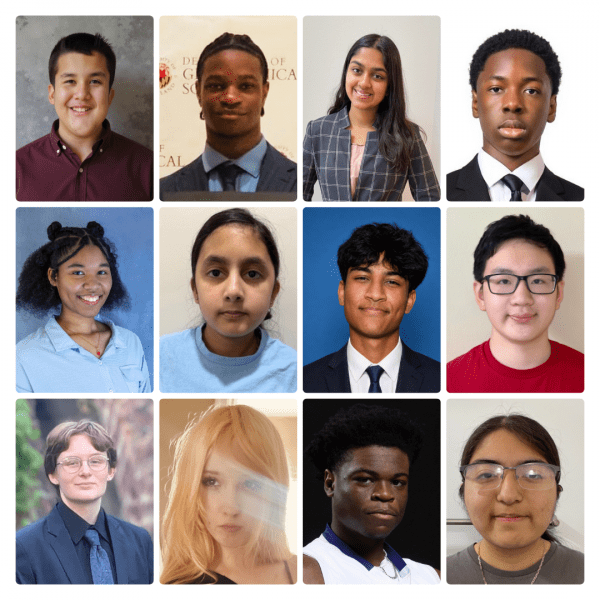
The summer program gave high school students the opportunity to contribute to faculty-led research and explore pathways in geographical sciences.
More than 7,000 satellite images still needed to be processed, and high school intern Oluwamayomide "Mayomide" Adeduro couldn't get his JavaScript code to work. He and research partner Oluwafikayo "Fikayo" Owoseni were helping improve cloud detection in Landsat 8 satellite imagery—part of an ongoing research project using artificial intelligence and remote sensing.
As the day wound down, doctoral student mentor Ruichen Wang checked in, learned what was happening and stayed on Zoom with Mayomide until nearly 2 a.m., helping him troubleshoot the problem.
For Mayomide, the experience became a defining moment of the Department of Geographical Sciences' High School Internship Program (HIP).
"That truly solidified my belief that the mentors of the GEOG program genuinely care about their interns and also seek to foster the next generation," he said. "His dedication inspires me."
Mayomide's experience was far from unique. Mentorship is at the heart of HIP, a six-week summer internship where high school students work alongside faculty members, graduate students and research staff to tackle real-world challenges through geospatial research.
This summer, 12 students from high schools across the region participated in eight faculty-led research projects using artificial intelligence, remote sensing, geographic information systems (GIS) and data analysis. Their work explored topics ranging from cloud detection and weather forecasting to land use change, climate resilience and environmental sustainability.
"I've always been optimistic about what students can achieve if they are properly motivated and resourced," said Professor George Hurtt, who launched HIP in 2023. "But it has been truly amazing to see what high school students can achieve as part of this program in just six short weeks."
The program's highly selective students progressed from learning new concepts to conducting advanced analyses on real-world problems.
"They are able to ramp up from basic knowledge to advanced analyses using the latest technology on topics of critical importance," Hurtt said. "The aptitude of these students is truly off the charts."
Students Apply AI and Remote Sensing
For many students, HIP was their first opportunity to contribute to authentic scientific research.
Working on the cloud detection project, Fikayo discovered how computer science can help solve environmental challenges.
"This experience meant a lot to me because it was my first time contributing to a real research project," he said. "It showed me how computer science and geospatial technology can be used to solve real-world problems."
The work also taught him the importance of careful data preparation. Distinguishing clouds from other bright features in satellite imagery required patience, but it helped him understand how high-quality data directly affects the performance of artificial intelligence models.
Mayomide said the internship reshaped how he viewed geography.
"I want to major in public health, but my mentor Dr. Xie helped me realize that geography is a vital part of public health as well," he said. "Geographic analysis identifies disparities in healthcare access, helps map where diseases occur and explains how environmental factors affect health."
Learning JavaScript, Google Earth Engine and Google Colab while contributing to an active research project also changed how he thinks about research itself.
"I think it's helped me realize that it's OK to spend a little extra time on a project," he said. "The finished product will bring a newfound level of satisfaction."
Research Experience Inspires Future STEM Careers
Tiffany Peyton entered HIP with a broad interest in science and left with a clearer sense of her academic path.
Her project explored ways to estimate cloud base height using ground-based sky cameras, helping improve weather observations. Using Python, she developed algorithms while strengthening both her technical and communication skills.
"The most rewarding part of this internship was having the opportunity to work alongside my mentors and researchpartner to learn and understand fascinating concepts that I doubt I would have discovered otherwise," she said.
Presenting the team's research at the end of the program became another highlight.
"After spending six weeks with the content, it felt wonderful to be able to explain it to others," Peyton said.
The experience helped her discover a passion for geography and meteorology.
Frank Lin experienced a similar transformation while helping develop an AI model to detect newly planted trees for Maryland's Five Million Trees Initiative.
"The most rewarding part was seeing all the pieces of the project come together," Lin said. Throughout the internship, he learned how AI and machine learning can support environmental monitoring while developing new technical and research skills.
"I learned that in research, you have to keep asking why something worked or did not work," he said. "By the end of the internship, I've gained a much greater interest in geographical sciences and using AI and machine learning to help solve real-world environmental problems."
Artificial intelligence also expands the scale of research students can undertake during the internship, Hurtt said.
"Previously, students might have had to manually classify entire remote sensing images," he said. "Now they can train computers using AI to do that. This enables them to study much larger areas in much shorter periods of time and increases the relevance of their work."
Collaboration Connects Students With Real-World Challenges
For Kaede Thomas, the internship reinforced that research is fundamentally collaborative.
Working with research partner Kavya Kumar on a project examining the impacts of data center expansion in northern Virginia, Kaede helped develop a framework for evaluating future data center sites based on environmental and geographic factors.
"The most important thing I've learned from this experience is how collaborative research can be," Kaede said. "We spent a lot of time working together to figure out challenges or next steps."
The collaboration extended beyond the university. Kaede and Kavya drew guidance from the Chesapeake Climate Action Network, where they are both involved, and later shared their findings with members of the environmental coalition. The experience gave them the opportunity to connect their research with an ongoing community conversation about data center development and its environmental impacts.
Faculty specialist Janna Chapman, who manages HIP in addition to serving as a project mentor, said that sense of purpose was evident throughout the program.
"These interns had a clear passion for researching and solving geographical problems," Chapman said. "That interest and dedication to solving problems they cared about showed throughout the entire program."
She said Kaede and Kavya’s presentation to the coalition was one example of how deeply students became engaged in their work.
"You could really tell how invested they were in their project, geographical sciences and the potential impact they could have on their community," Chapman said.
Preparing the Next Generation of Scientists
After four years leading HIP, Hurtt said one thing continues to stand out.
"It's all about discovery," he said. "Almost every day I am reminded of why HIP matters. Every day I see students learn something they didn't know before."
By the end of the program, those discoveries become research presentations with findings previously unknown to the students, their advisors and, in many cases, to science.
Chapman said the experience often helps students realize where they want to go next.
"A lot of students might not know what direction they want to pursue in school," she said. "This experience helps them solidify what they're interested in and encourages them to feel confident pursuing education in geographical sciences."
For Mayomide, the internship demonstrated not only how AI and geospatial science can address real-world challenges but also the value of asking for help and learning alongside experienced mentors.
"I would highly recommend this internship to any applicable high schoolers regardless of your field of interest," he said. "No matter what you become, geography will most likely play a part in it, especially if it's a STEM career. Also, don't be afraid to ask questions!"
Student Projects
- "Pretraining Cloud Segmentation Models Using Machine Learning" by Oluwafikayo Owoseni (CMIT South High School) and Oluwamayomide Adeduro (Eleanor Roosevelt High School), mentored by Ruichen Wang, Yiqun Xie and Haizhao Yang
- "Development of an AI Verification Model: Using Remote Sensing to Detect New Tree Plantings" by Anna Fedorova (College Park Academy), Frank Lin (Montgomery Blair High School), mentored by George Hurtt, Quan Shen and Janna Chapman
- "Analyzing Data Center Site Selection and Land Use Impacts in Prince William County, Virginia" by Kavya Kumar (Independence High School) and Kaede Thomas (Patriot High School), mentored by Zhenhua Zhu
- "Estimating Cloud Height From Ground-Based Skycam Images" by Syna Singh (Marriotts Ridge High School) and Tiffany Peyton (Ad Astra Cooperative Learning High School), mentored by Sergii Skakun, Andres Santamaria Artigas, Arti Tiwari and Eric Vermote
- "How Has Storm Surge Risk Increased in the Chesapeake Bay as a Result of Rising Sea Levels?" by Amelia M. Herrera (College Park Academy), mentored by Evan Ellicott.
- "Wildfire-Related Transmission Line Exposure Near Phoenix Data Center Market" by Ryan Kovacs (South Lakes High School), mentored by Evan Ellicott
- "Evaluating Miami-Dade Supply Chain Flood Risks" by Jesse Wright (DeMatha Catholic High School), mentored by Ashleigh Price
- "Spatial Analysis of Cultural Risk on Majuli Island" by Advaith Thambisetty (Centennial High School), mentored by Ashleigh Price
The Department of Geographical Sciences would like to thank this year’s HIP mentors:
- Assistant Research Professor Andres Santamaria Artigas
- Faculty Specialist Janna Chapman
- Associate Research Professor Evan Ellicott
- Professor George Hurtt
- Assistant Research Professor Ashleigh Price
- Postdoctoral Associate Quan Shen
- Associate Professor Sergii Skakun
- Postdoctoral Associate Arti Tiwari
- Emeritus Research Professor Eric Vermote
- Ph.D. student Ruichen Wang
- Associate Professor Yiqun Xie
- Professor Haizhao Yang (CMNS)
- Assistant Research Professor Zhenhua Zou
HIP is supported by the University of Maryland’s Grand Challenges Institutional Grant, the department’s Young Researcher’s Fund and individual donors. You can support the High School Hub by making a donation. Students receive a $900 stipend for their participation, and many continue their projects into the academic year or science fair season.
Published on Mon, 08/03/2026 - 11:04