

High School Intern Advances Earth Monitoring with AI
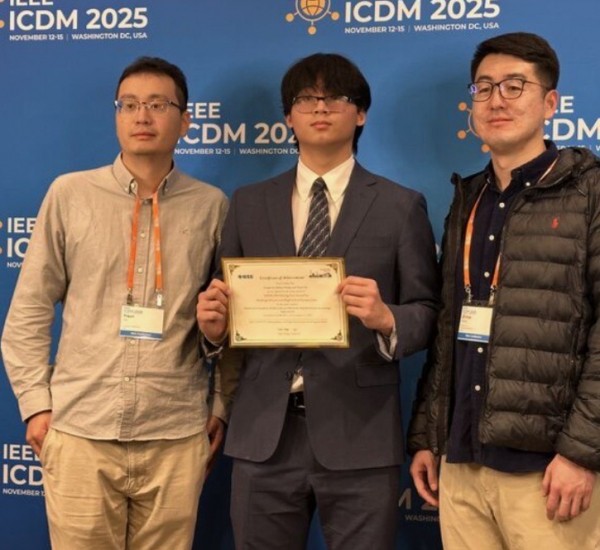
With mentoring from Assistant Professor Yiqun Xie and Ph.D. student Zhihao Wang, Cooper Li explores an easy-to-implement AI framework for remote sensing
Instead of spending free time on games and social media, Cooper Li, a senior at Montgomery Blair High School in Silver Spring, Maryland, is using artificial intelligence to map the Earth. His work has already earned him the Rising Star Award at the Undergraduate and High School Symposium of the IEEE International Conference on Data Mining 2025.
During a yearlong internship with Assistant Professor Yiqun Xie’s lab in the Department of Geographical Sciences, Li developed a method to tackle a major challenge in large-scale remote sensing: spatial variability. As a simplified example, visual cues in images can represent different things depending on where it appears, such as snow in Antarctica or white sand in New Mexico, and models often struggle to perform accurately across regions. Li’s approach uses multimodal foundation models to route image patches and textual data to specialized expert models, showing promising performance improvements in tasks like dead tree detection.
To tackle that problem, Li explored an approach that uses multimodal foundation models as routers for remote sensing image segmentation. Instead of applying a single model across an entire dataset, his system examines an image patch alongside textual information such as metadata, geographic context and related descriptions. The foundation model identifies general patterns and routes the image to a specialized expert model trained to handle similar characteristics. Testing the method on dead tree detection, Li recorded significant improvements over the baseline.
Xie said Li’s professionalism and energy stood out immediately.
“Cooper is always strongly motivated, firmly dedicated and highly efficient,” he said. “He is very active in communication and delivers consistently and early. He brings impressive energy to the projects and we all very much enjoyed having him as part of the team.”
Xie noted that Li’s work offers a new angle for using foundation models like GPT or Gemini to address spatial variability in large-scale Earth monitoring. The approach could lead to easier tools for practitioners and broaden access to advanced remote sensing analysis.
Li began the internship with little experience in AI or data mining. Ph.D. student Zhihao Wang, who met with Li regularly to build his skills, described an intern who was eager to learn and quick to adapt.
“Cooper quickly absorbed new material, asked thoughtful questions, and consistently applied feedback to improve both his technical skills and scientific reasoning,” Wang said. “His progress is a direct reflection of his hard work and curiosity, and we are very proud to have mentored him throughout this project.”
The motivation behind Li’s research is tied to the rapid growth of open-source data and the AI tools that interpret it.
“Every year, more and more data becomes easily accessible thanks to new technologies,” Li said. “As a high school student, I believe one of the best things I can do to adapt to a world changing so quickly is to explore the fields driving that change.”
Li credits Xie for helping him shape the project and understand how to present his findings. “I’ve worked with Dr. Xie for almost one and a half years now, and he’s been incredibly helpful in fostering my interest in AI and data mining, and giving me projects that are useful for my learning. He helped me decide on this project and gave me not only technical guidance on my research, but also non-technical guidance on how to present it.”
That support paid off when Li received the Rising Star Award. The recognition came as a surprise. “I didn’t actually even know that this was an award that could be won, but I’m happy that my work was acknowledged, and I’m proud of the research that I did,” Li said.
In college, Li plans to study mechanical or electrical engineering and explore how AI can enhance robotics and design tools. He sees his AI work as a foundation for future engineering innovations.
Image: From left to right, Assistant Professor Yiqun Xie, Cooper Li and Ph.D student Zhihao Wang at the UGHS Symposium at IEEE ICDM on Nov. 15 in Washington, DC.
Published on Tue, 12/02/2025 - 15:47