
UMD College of Behavorial & Social Sciences UMD College of Behavorial & Social Sciences
MENU

Topbar Menu

  • About Us
  • People
  • Alumni and Giving
  • Undergraduate
    • Prospective Students
    • Courses & Facilities
    • Advising
    • Special Programs
    • Graduation
    • Geography Club
  • Graduate
    • Prospective Ph.D. Students
    • Graduate Courses
    • Graduate Student Publications
    • Graduate Student Awards
    • Graduate Students
    • Master of Science and Graduate Certificate Programs
    • Combined BS/MS Program
  • Research
    • Research Areas
      • Geospatial-Information Science and Remote Sensing
      • Human Dimensions of Global Change
      • Land Cover and Land Use Change
      • Carbon, Vegetation Dynamics and Landscape-Scale Processes
    • Centers
      • Center for Geospatial Information Science
      • International Center for Innovation in Geospatial Analytics & Earth Observation
  • High School Hub
    • Program Overview
    • High School Awards
    • High School Internship Program
    • GIS Day
    • Request a Geographer
  • Resources
    • Graduate Student Organization
    • Student Life
    • Graduate School
    • Responsible Conduct of Research
    • Emergency Preparedness
    • Job Opportunities
    • Graduation
Search

Main navigation

  • Undergraduate
    • Prospective Students
    • Courses & Facilities
    • Advising
    • Special Programs
    • Graduation
    • Geography Club
  • Graduate
    • Prospective Ph.D. Students
    • Graduate Courses
    • Graduate Student Publications
    • Graduate Student Awards
    • Graduate Students
    • Master of Science and Graduate Certificate Programs
    • Combined BS/MS Program
  • Research
    • Research Areas
      • Geospatial-Information Science and Remote Sensing
      • Human Dimensions of Global Change
      • Land Cover and Land Use Change
      • Carbon, Vegetation Dynamics and Landscape-Scale Processes
    • Centers
      • Center for Geospatial Information Science
      • International Center for Innovation in Geospatial Analytics & Earth Observation
  • High School Hub
    • Program Overview
    • High School Awards
    • High School Internship Program
    • GIS Day
    • Request a Geographer
  • Resources
    • Graduate Student Organization
    • Student Life
    • Graduate School
    • Responsible Conduct of Research
    • Emergency Preparedness
    • Job Opportunities
    • Graduation
  • About Us
  • People
  • Alumni and History
  • Diversity

Search our site:

Fire on Ice: The Arctic’s Changing Fire Regime
Breadcrumb

  • Home
  • Featured Content
  • Fire On Ice: The Arctic’s Changing Fire Regime
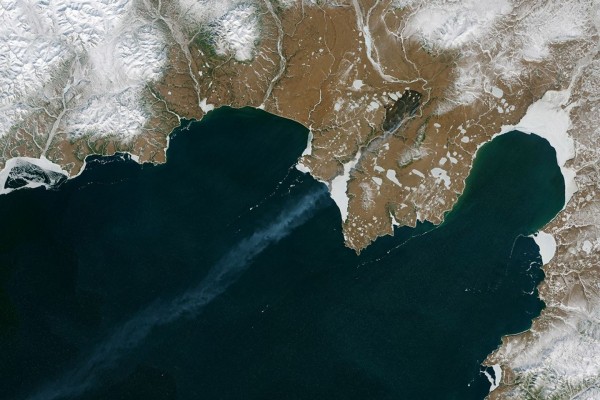
A satellite view shows a snow-dusted, brown coastline where a long, misty plume originates from a dark land scar and stretches across a deep teal sea. Bright white sea ice and frozen lakes contrast with the dark water and rugged tundra.

In a NASA's Earth Observatory feature drawing on a 2025 Arctic Council report, GEOG Chair Tatiana Loboda, explains why fire intensity is raising particular concern for Arctic ecosystems and the vast carbon stores locked in frozen ground.

The number of wildland fires burning in the Arctic is on the rise, according to NASA researchers. Moreover, these blazes are burning larger, hotter, and longer than they did in previous decades.

These trends are closely tied to the region’s rapidly changing climate. The Arctic is warming nearly four times faster than the global average, a shift that directly impacts rain and snow in the region and decreases soil moisture, both of which make the landscape more flammable. Lightning, the primary ignition source of Arctic fires, is also occurring farther north. These findings are detailed in a report published in 2025 by the Arctic Monitoring and Assessment Programme (AMAP), a working group of the Arctic Council.

“Fire has always been a part of boreal and Arctic landscapes, but now it's starting to act in more extreme ways that mimic what we've seen in the temperate and the tropical areas,” said Jessica McCarty, Deputy Earth Science Division Chief at NASA’s Ames Research Center and an Arctic fire specialist. McCarty, the report’s lead author, worked as part of an international team for AMAP.

But it’s not just the number of fires that concerns scientists; it’s how hot they burn.

“It's the intensity that worries us the most because it has the most profound impact on how ecosystems are changing,” said Tatiana Loboda, chair of the Department of Geographical Sciences at the University of Maryland. 

Read the Full Article

Published on Thu, 01/15/2026 - 10:17

College of Behavioral & Social Sciences
  • Facebook
  • Twitter
  • Instagram
  • YouTube
  • LinkedIn
  • Zenfolio

Department of Geographical Sciences

2181 Samuel J. LeFrak Hall, 7251 Preinkert Drive,
University of Maryland, College Park, MD 20742
Phone: 301-405-4050

Subscribe to Our Newsletter

Contact Us

Links
  • UMD Land Acknowledgement
  • UMD Staff Directory
  • Give to GEOG
  • UMD Web Accessibility
  • Alumni
© 2026 College of Behavioral & Social Sciences. All Rights Reserved.
Login