
UMD College of Behavorial & Social Sciences UMD College of Behavorial & Social Sciences
MENU

Topbar Menu

  • About Us
  • People
  • Alumni and Giving
  • Undergraduate
    • Prospective Students
    • Courses & Facilities
    • Advising
    • Special Programs
    • Graduation
    • Geography Club
  • Graduate
    • Prospective Ph.D. Students
    • Graduate Courses
    • Graduate Student Publications
    • Graduate Student Awards
    • Graduate Students
    • Master of Science and Graduate Certificate Programs
    • Combined BS/MS Program
  • Research
    • Research Areas
      • Geospatial-Information Science and Remote Sensing
      • Human Dimensions of Global Change
      • Land Cover and Land Use Change
      • Carbon, Vegetation Dynamics and Landscape-Scale Processes
    • Centers
      • Center for Geospatial Information Science
      • International Center for Innovation in Geospatial Analytics & Earth Observation
  • High School Hub
    • Program Overview
    • High School Awards
    • High School Internship Program
    • GIS Day
    • Request a Geographer
  • Resources
    • Graduate Student Organization
    • Student Life
    • Graduate School
    • Responsible Conduct of Research
    • Emergency Preparedness
    • Job Opportunities
    • Graduation
Search

Main navigation

  • Undergraduate
    • Prospective Students
    • Courses & Facilities
    • Advising
    • Special Programs
    • Graduation
    • Geography Club
  • Graduate
    • Prospective Ph.D. Students
    • Graduate Courses
    • Graduate Student Publications
    • Graduate Student Awards
    • Graduate Students
    • Master of Science and Graduate Certificate Programs
    • Combined BS/MS Program
  • Research
    • Research Areas
      • Geospatial-Information Science and Remote Sensing
      • Human Dimensions of Global Change
      • Land Cover and Land Use Change
      • Carbon, Vegetation Dynamics and Landscape-Scale Processes
    • Centers
      • Center for Geospatial Information Science
      • International Center for Innovation in Geospatial Analytics & Earth Observation
  • High School Hub
    • Program Overview
    • High School Awards
    • High School Internship Program
    • GIS Day
    • Request a Geographer
  • Resources
    • Graduate Student Organization
    • Student Life
    • Graduate School
    • Responsible Conduct of Research
    • Emergency Preparedness
    • Job Opportunities
    • Graduation
  • About Us
  • People
  • Alumni and History
  • Diversity

Search our site:

Eos: 'Creating Communities to Help Interdisciplinary Scientists Thrive'
Breadcrumb

  • Home
  • Featured Content
  • Eos: 'Creating Communities To Help Interdisciplinary Scientists Thrive'
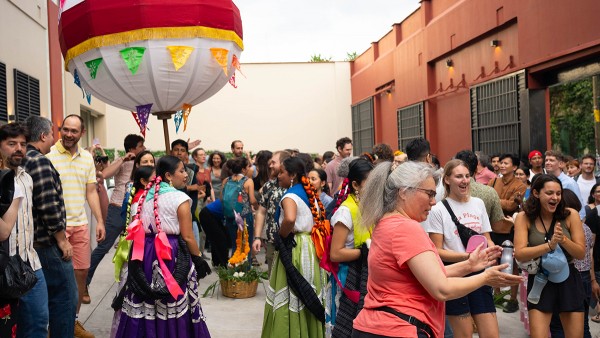
A large, diverse group of people gathers in an outdoor courtyard in Oaxaca, Mexico, for a lively social event. In the foreground, two women in traditional Oaxacan dress—vibrant purple and green skirts with intricate white lace and ribbons braided into their hair—stand near a large, white and red decorative ceremonial balloon (marmota) adorned with colorful papel picado flags. Around them, many other attendees in casual attire are smiling, talking, and dancing. The background features warm, terracotta-colore

Global Land Programme's Laura Vang Rasmussen, Rachael Garrett, A. Sofia Nanni, Navin Ramankutty and Ariane de Bremond discuss the challenges interdisciplinary scientists face and how global communities can provide support and impact in this article on AGU’s Eos magazine.

Scientists who work across disciplines often dread the question, “What is your field of expertise?” A geographer working in an environmental science department or a social scientist working in an ecology department might find it difficult to articulate how their research, knowledge, and professional networks fit within established fields to colleagues long accustomed to their institutions’ disciplinary expectations and norms.

Most academic structures are still largely organized around relatively narrow disciplinary perspectives, even as the world’s biggest challenges require interdisciplinary solutions.

These moments of discomfort may seem trivial, but they signal a systemic barrier for many scientists and for scientific innovation and problem-solving: Most academic structures are still largely organized around relatively narrow disciplinary perspectives, even as the world’s biggest challenges require interdisciplinary solutions. Addressing natural hazards, biodiversity loss, poverty, and food insecurity simultaneously, for example, depends on scientists collaborating across fields and engaging with partners in other sectors of society.

This issue is not just one of semantics, especially for younger scientists and others who regularly experience its effects. Departments incentivized to select against interdisciplinary science and the absence of clear institutional “homes” for interdisciplinary scientists can create challenges for hiring, evaluation, and promotion. It can also reduce researchers’ sense of professional belonging and increase their feelings of being an imposter, which can affect their ability to contribute and even lead to the loss of scientific talent to other career paths.

Experiences in the field of land system science reflect broader tensions with interdisciplinarity across academic science. Researchers studying land system science, as we do, often find that their work resists neat disciplinary labels. Because this field encompasses the many ways that people and nature interact across Earth’s land surface and how these interactions shape global challenges like biodiversity loss, it can be difficult to describe the field in terms of preexisting academic departments and to identify appropriate funding sources and publication venues.

Here we share experiences navigating tensions that have come with pursuing interdisciplinary science, and we describe how one global interdisciplinary science community, the Global Land Programme (GLP), became a home for our work. Communities such as the GLP not only bring people together but also help create new pathways for turning research into solutions.

Read the full article on Eos

Image: Attendees socialize during an event at the 5th Open Science Meeting for the Global Land Programme (GLP) in Oaxaca, Mexico, in 2024. Credit: Ximena Fargas

Published on Fri, 02/13/2026 - 14:08

College of Behavioral & Social Sciences
  • Facebook
  • Twitter
  • Instagram
  • YouTube
  • LinkedIn
  • Zenfolio

Department of Geographical Sciences

2181 Samuel J. LeFrak Hall, 7251 Preinkert Drive,
University of Maryland, College Park, MD 20742
Phone: 301-405-4050

Subscribe to Our Newsletter

Contact Us

Links
  • UMD Land Acknowledgement
  • UMD Staff Directory
  • Give to GEOG
  • UMD Web Accessibility
  • Alumni
© 2026 College of Behavioral & Social Sciences. All Rights Reserved.
Login