

Associate Research Professor Vera Kuklina Contributes to Fairbanks Biocultural Heritage Mural Initiative
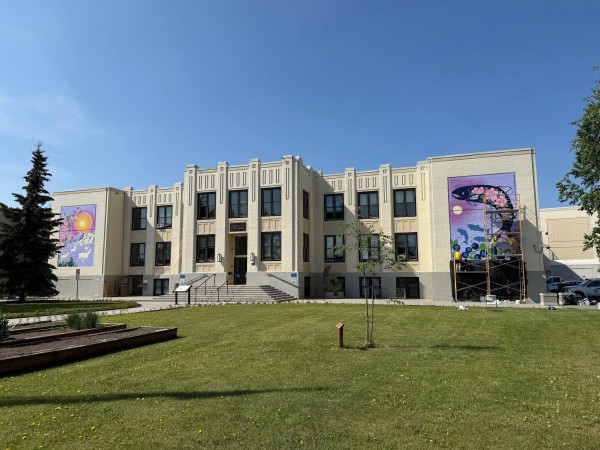
NSF-funded ARCA project brings Indigenous knowledge and community storytelling to public art in interior Alaska.
From June 6 to 12, Alaska Native artists, Elders, community organizations, the City of Fairbanks and researchers completed two murals on the façade of Fairbanks City Hall as part of the Biocultural Heritage in Arctic Cities as a Potential Resource for Climate Adaptation (ARCA) project. Funded by the National Science Foundation, the ARCA project is led by Vera Kuklina, an associate research professor in the Department of Geographical Sciences (GEOG).
The murals were developed through a yearlong co-creative process grounded in community knowledge and Indigenous storytelling. Workshops, talking circles and collaborative design sessions brought together Elders, youth, artists, researchers and community members to share memories, concerns and hopes for life in interior Alaska. These conversations guided the visual concepts for the murals and ensured they reflected local relationships to land, water and culture.
The final designs depict key elements of life in the Tanana Valley, including caribou, salmon, wild roses and blueberries, as well as seasonal subsistence practices such as fishing and foraging. A view of Denali from Fairbanks anchors one side of the mural, while salmon emphasizes enduring relationships between Alaska Native peoples and the region’s rivers.
ARCA’s research on Indigenous knowledge, urbanization and climate adaptation in Arctic cities is informed by Kuklina’s expertise in social and cultural geography and Indigenous fieldwork. Her research has been published in Polar Geography, Geoforum, Sibirica and other international and Russian journals.
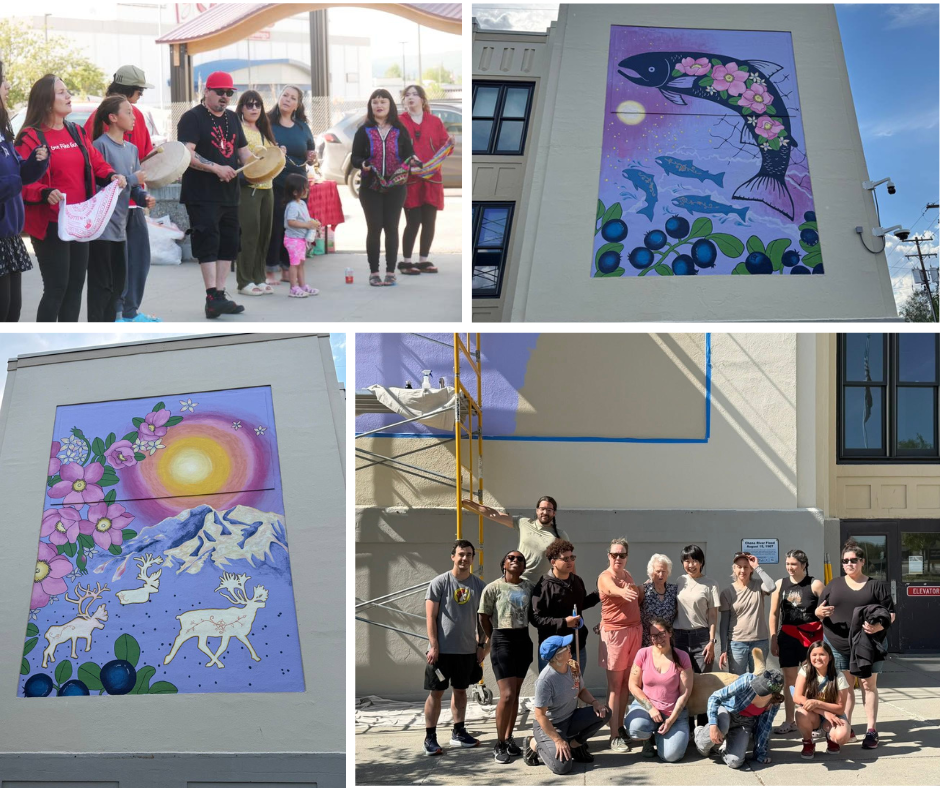
Clockwise from top left: Community members, Alaska Native artists and Elders gather to sing and drum; a newly completed vertical mural on Fairbanks City Hall features a salmon, wild roses and blueberries; the project’s artists and research team pose beneath scaffolding; a second mural panel depicts a bright sun over Denali, along with caribou and wild berries.
Kuklina said the initiative reflects meaningful collaboration among researchers, artists and local and Indigenous communities: “This project highlights how research aligned with Indigenous principles of respect, responsibility, reciprocity and relationality, amplified by collaboration with artists, can not only lead to a better understanding of human-environment relations but also contribute to local culture and social cohesion, and inspire a better future.”
The murals were developed in close collaboration with Native Movement, Denakkanaaga Elders, Alaska Native artists and the City of Fairbanks, with multiple rounds of community and municipal review. They now stand as a public expression of biocultural heritage, shared stewardship and Indigenous knowledge in Arctic urban futures.
The research team now plans to reflect on this experience to offer good practices for knowledge co-creation to other scholars interested in transdisciplinary research. They also plan to organize a workshop in Tromsø, Norway, to compare and further improve understanding of biocultural heritage in Arctic cities by working with local scholars, artists, Sámi and other stakeholders. The project's final outcomes will help identify how traditional ecological knowledge embedded in local cultures and landscapes can inform adaptation strategies in the urban Arctic.
The emphasis on knowledge co-creation extends beyond ARCA and is a hallmark of Kuklina's broader research program. In her NSF-funded Frozen Commons project, which examines the impacts of permafrost thaw on communities in Mongolia, artist and photographer Natalya Saprunova joined a research expedition to document changing permafrost landscapes through visual storytelling. Her work, developed in collaboration with scientists and local communities, was recently featured in The Guardian. Like the Fairbanks mural project, Frozen Commons uses artistic collaboration to help communicate community knowledge and lived experiences of environmental change.
Photos courtesy of Vera Kuklina, taken by herself, Jaenell Manchester and Diana Khaziakhmetova
Published on Mon, 06/22/2026 - 03:23