

Assistant Research Professor Abdul Qadir Receives AGU Science for Solutions Award
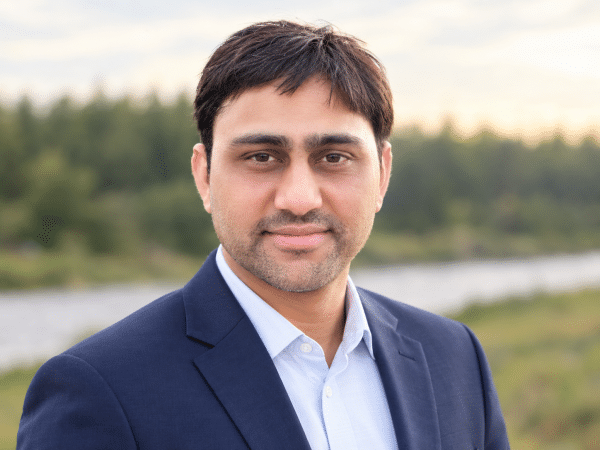
Qadir is recognized for applying satellite remote sensing and machine learning to agricultural challenges in data-sparse regions.
Assistant Research Professor Abdul Qadir in the Department of Geographical Sciences (GEOG) has been selected to receive the 2026 Science for Solutions Award from the American Geophysical Union (AGU) for his work applying Earth and space science to societal challenges.
A geospatial data scientist, Qadir uses satellite remote sensing and machine learning to develop timely agricultural information in regions where conventional field-based data collection can be challenging or financially impractical.
“I believe I was selected for the AGU Science for Solutions Award because of my commitment to using Earth observation, satellite remote sensing and machine learning to address real-world challenges in food security and agricultural statistics,” Qadir said.
During his Ph.D., he developed satellite- and machine-learning-based approaches to monitor agricultural production and estimate crop areas across Ukraine during the war, providing near-real-time information.
“The beauty of Abdul’s work is how he progressed from using satellite data to study crops, to mapping crop types and estimating crop areas, and then delivering these outputs to end users for decision-making,” said Sergii Skakun, associate professor and associate chair at the department.
Research Professor Inbal Becker-Reshef, who directs NASA Harvest, said Qadir’s work has helped fill critical information gaps and provide a more complete picture of Ukraine during the war.
“His work on sunflower, maize and soybeans has been instrumental in our support to Ukraine’s Ministry of Agriculture, helping assess production in occupied territories,” she said.
Qadir has extended his work to other data-sparse regions and disaster response, including a rapid assessment of crop impacts during the 2025 floods in Punjab, Pakistan. He has also contributed to efforts to integrate Earth observation into agricultural statistics at the national level.
“Building on his research, Abdul is supporting our team’s collaboration with the Kenyan Ministry of Agriculture and Livestock Development, the Microsoft AI for Good Lab and other national and international partners to assess the impacts of the severe drought on maize production in Kenya through the ADAPT and RAAPID initiatives,” Becker-Reshef said. “He stays focused on the questions our partners need answered and how his research can help.”
Qadir’s research was also included in the United Nations Handbook on Remote Sensing for Agricultural Statistics as an example of how satellite data can be used for statistical applications.
The AGU Science for Solutions Award is given annually to a student or postdoctoral scientist in recognition of significant contributions in the application of Earth and space science to solve societal problems.
“Receiving the AGU Science for Solutions Award is a tremendous honor and meaningful recognition of the broader purpose of my research: using science and technology to address problems that directly affect society,” Qadir said. “This award motivates me to continue developing practical, science-based solutions and working with researchers, governments, international organizations and other stakeholders to translate Earth observation science into actionable information.”
Qadir will be recognized at AGU’s 2026 Annual Meeting Dec. 7 to 11 in San Francisco, California, along with other honorees.
Image courtesy of Abdul Qadir
Published on Fri, 10/02/2026 - 09:30