

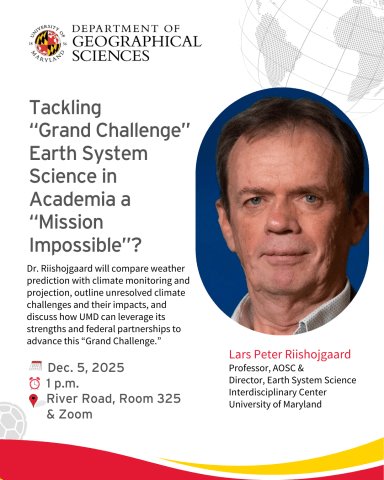
Tackling “Grand Challenge” Earth System Science in Academia a “Mission Impossible”?
Join us for a special talk with ESSIC Professor Lars Peter Riishojgaard at 1 p.m. this Friday, Dec. 5 in River Road.
Climate change is affecting quality of life, national economies, livelihoods and food security worldwide. Societies will need to mitigate and/or adapt to climate change, but for them to do so efficiently and effectively, a quantum leap forward in scientific understanding of climate and climate change will be required.
Experience with weather forecasting has taught us that complex problems of a planetary scale will require large-scale coordinated efforts. However, in contrast to most weather-related research, climate science funding remains highly fragmented, and therefore the research tends to be undertaken in small groups and collaborations between them are centered on scientific publications, not on large-scale observing, model or IT systems.
We will look at some of the parallels and differences between weather prediction on one hand and climate monitoring/prediction/projection on the other. We will then look at some of the climate science problems that we have been (and continue to be) unable to solve and of the societal implications of this, and we will close by discussing how UMD might wish to use its unique position and academic resources and its relationship with the federal government to rethink its approach to this particular “Grand Challenge” research area.
Speaker
Dr. Lars Peter Riishojgaard is Professor in Atmospheric and Ocean Science and the Director of the Earth System Science Interdisciplinary Center at the University of Maryland in College Park, MD. From 2014 to 2023 he worked in the World Meteorological Organization in Geneva, Switzerland as Director of the Global Greenhouse Gas Watch, which will provide near-real time estimates of greenhouse gas fluxes to support climate change mitigation action. He was previously the Director of the WMO Integrated Global Observing System and led the development of the Unified WMO Data Policy and the Global Basic Observing System.
Prior to joining WMO, Dr. Riishojgaard spent most of his career in the US working on NASA programs, and he was Director of the US interagency Joint Center for Satellite Data Assimilation from 2007 to 2014. His main areas of interests are numerical weather prediction, observational data impact, greenhouse gas monitoring, and policy issues related to weather and climate data.
Dr. Riishojgaard has an MSc in geophysics (thesis in glaciology) and a Ph.D in geophysics (thesis in climate modeling) from the University of Copenhagen.
For the Zoom link, please visit the GEOG Department Calendar.
When:
to:
Where:
River Road, Room 325 (Zoom available)
Speakers:
Professor Lars Peter Riishojgaard, Atmospheric and Ocean Science and Director of the Earth System Science Interdisciplinary Center