

Seminar: "Forest Disturbances and Changing Biosphere-Atmosphere Coupling in the Brazilian Amazon"
Join us Thursday, Feb. 26 at 11 a.m. for a special seminar on how disturbances reshape Amazonian forests and their carbon, water and energy cycles.
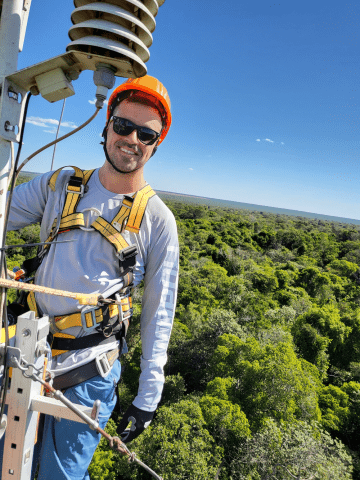
This lecture focuses on forest disturbances and their role in regulating biosphere-atmosphere coupling in the Brazilian Amazon, with particular emphasis on deforestation, forest degradation, extreme droughts and fire. By integrating observations across multiple spatial scales — from leaf-level ecophysiological measurements to ecosystem-scale eddy covariance flux towers and satellite remote sensing — the presentation examines how disturbances reshape the exchanges of energy, water and carbon that underpin Amazonian forest functioning.
The talk highlights how both short-term extreme events, such as severe droughts and wildfires, and long-term pressures, including fragmentation and progressive degradation, fundamentally reorganize forest structure and ecosystem processes. These changes directly affect evapotranspiration, carbon uptake, and forest productivity, altering how Amazonian ecosystems function across disturbed landscapes. Particular attention is given to compound disturbances and evidence that repeated or overlapping stressors can push forest systems toward new functional states.
By synthesizing long-term observations with recent advances in remote sensing and flux measurements, the lecture offers a process-based view of Amazonian forest vulnerability and resilience under environmental change.
Speaker Bio
Dr. Gabriel de Oliveira is an Assistant Professor at the University of South Alabama and a Senior Scientist I at the Dauphin Island Sea Lab. He is also an Early-Career Fellow of the U.S. National Academy of Sciences (NAS) and an Ambassador of the American Geophysical Union (AGU).
Over the past 15 years, his research has focused on the Amazon, investigating how deforestation, fire and drought alter ecosystem processes and the exchange of water and carbon between the biosphere and the atmosphere. His work primarily integrates satellite remote sensing, field-based ecological measurements and eddy covariance flux tower observations to understand ecosystem functioning, disturbance impacts and resilience across tropical landscapes.
He earned his BSc in Geography from the Federal University of Rio Grande do Sul (UFRGS), Brazil, and his MSc and PhD in Remote Sensing from Brazil’s National Institute for Space Research (INPE). He was a postdoctoral researcher at the University of Kansas and at the University of Toronto and has additionally served as a Distinguished Visiting Professor at Tel Aviv University, Israel.
For the Zoom link, please visit the GEOG Department Calendar.
When:
to:
Where:
River Road, Room 325
Host:
André de Lima, Assistant Research Professor
Speakers:
Gabriel de Oliveira, Assistant Professor, University of South Alabama | Senior Scientist I, Dauphin Island Sea Lab