

Konrad Wessels, "Elephants as Ecosystem Engineers of Vegetation Structure & Above-Ground Carbon Stocks"
Join us at 3:30 p.m. on Thursday, April 30 in River Road Room 325 for this seminar with Associate Professor Konrad Wessels at George Mason University.
In this seminar, Wessels will unravel the role of African elephants as ecosystem engineers by quantifying their density-specific impacts on woody biomass / carbon stocks in savannas.
The study focuses on a network of private reserves adjacent to Kruger National Park (KNP) in South Africa, which has been removing their fences during the last 25 years, and as recently as 2016-2019 — followed by an influx of elephants from KNP and significant changes in woody vegetation.
This juxtaposition of different elephant densities enabled novel investigations at spatial and temporal scales rarely explored, by combining long-term field data and a dense time series of L-band Synthetic Aperture Radar (SAR) data (2014-2023).
The study underscores the much-debated “elephant-management-paradox” that highlights potential conflicts between elephant conservation and “natural climate solutions” aimed at conserving savanna carbon stocks, habitat heterogeneity and biodiversity in African conservation areas.
About the Speaker
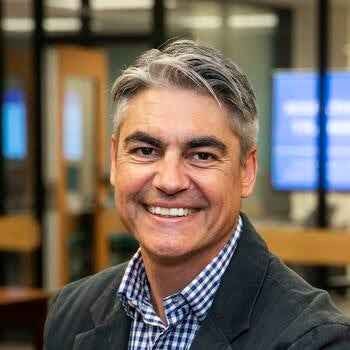
Wessels is a remote sensing expert and ecologist that specialises in the estimation of vegetation structure and biomass using airborne, drone- and space-based LiDAR and Synthetic Aperture Radar (SAR) in the arid Savannas of Africa, including Namibia, South Africa and Senegal.
He has published extensively on the drivers of woody vegetation change, including elephants, drought, fire and human fuelwood harvesting. He is best known for pioneering remote sensing and statistical methods for distinguishing the impact of rainfall variability from human-induced land degradation.
He has been selected to the following NASA Science teams: Surface Topography and Vegetation (STV) Incubation Study; Carbon Monitoring System program; EDGE Explorer mission and the ARID Terrestrial Ecology Scoping study. He is currently an Associate Professor in the Department of Geography and GeoInformation Science at George Mason University (2018 - present).
For the Zoom link, please visit the GEOG Department Calendar or contact Maggie Wooten, Ph.D student at @email.
When:
to:
Where:
River Road, Room 325 and Zoom
Host:
Maggie Wooten, Ph.D. Student
Speakers:
Konrad Wessels, Associate Professor, George Mason University